A sugar maple that handles drought. A bald cypress that stays green in alkaline soil. A southern wax myrtle that has survived temperatures well below zero. These are the kinds of plants that make a trip to Sunshine Nursery in Clinton, Oklahoma, so much fun.
About an hour west of Oklahoma City, this third-generation nursery is working with a combination of conditions that would discourage just about anybody: high soil pH, very little dependable rainfall, intense heat, drying wind, and temperatures that can fall off a cliff.
But spending time with Kadin there changes the question. Instead of asking what cannot grow in western Oklahoma, you start asking which population, which selection, or which rootstock might make a plant work. That is a much more interesting conversation, and it has plenty of value for gardeners far beyond the Great Plains.
Table of Contents
- Key Takeaways
- What Makes This Such a Difficult Place to Grow Plants?
- Where a Plant Comes From Can Matter as Much as Its Name
- Flowering Plants for Hot, Dry Garden Beds
- Caddo Maples: Sugar Maples With a Different Background
- Bald Cypress That Handle Alkaline Soil and Drought
- Why Sunshine Puts So Much Effort Into Roots
- The Same Oak, Different Rootstock, Very Different Results
- Expanding the Conifer Palette Through Trials
- Japanese Maples: Heat Tolerance Is Not Sun Tolerance
- Two Elm Selections Worth Paying Attention To
- Evergreens That Push Beyond Expectations
- What This Means for Your Own Difficult Garden Spots
- Fifty Years of Turning a Wheat Field Into Possibility
Key Takeaways
- A plant’s geographic origin can strongly influence its tolerance of alkalinity, drought, and temperature swings.
- Adapted rootstocks can improve the performance of ornamental cultivars in difficult soils.
- Heat tolerance does not automatically mean tolerance of intense sun, dry air, and wind.
- Well-developed roots and irrigation matched to plant needs support success in harsh growing conditions.
What Makes This Such a Difficult Place to Grow Plants?
At Sunshine Nursery, the soil pH is roughly 8.4 to 8.5, with variation across the property. Kadin says none of their ground is below 8. Their irrigation water is even higher, around 8.6.
Soil pH affects whether plants can access nutrients, not simply whether those nutrients are present. A soil can contain iron and still leave a poorly adapted tree unable to use enough of it. The result can be chlorosis: foliage that turns yellow instead of maintaining a healthy green color. For more background, University of Minnesota Extension explains iron chlorosis and its relationship to alkaline soils.
That makes alkalinity the first hurdle. Then come the weather extremes:
- Heat: Kadin described a particularly brutal summer with about 60 days above 100°F and 130 days above 90°F, with temperatures reaching roughly 110°F.
- Drought: Annual rainfall is around 20 inches, but it does not arrive in convenient, evenly spaced amounts.
- Cold: Severe winters can bring temperatures into the negative teens or negative twenties.
- Rapid swings: Winter warmth in the 60s or 70s can be followed by a plunge below zero.
That last point matters enormously. A tree may tolerate deep cold while fully dormant but suffer when warmth gets it active before another hard freeze. Kadin sees damage to the cambium, the living tissue just beneath the bark, when plants are caught by those changes.
Even the rainfall total needs some explanation. Shortly before our visit, nearly 8 inches arrived in one week after much of the year had delivered only 6 to 8 inches. A big storm does not replace months of useful moisture. Some of that water simply leaves before plants can benefit from it.
Where a Plant Comes From Can Matter as Much as Its Name
One of the most useful ideas running through Sunshine’s work is provenance: the geographic origin of the plant material.
A species can occupy a broad range without every population having identical tolerances. An isolated, or disjunct, population may have persisted for generations under conditions very different from those associated with the species elsewhere.
That is why “native” alone does not finish the plant-selection conversation. A tree native to wet, acidic ground in the Southeast may struggle badly in western Oklahoma. A population of that same species growing around limestone in Texas may offer something entirely different.
Sunshine’s family learned this through experience. Selling the usual nursery plants was not much of a solution if customers returned the next year to replace them. Establishing a tree here takes real effort. The goal is to make that effort worthwhile.
Northern red oaks and pin oaks, for example, can remain chlorotic despite generous watering. Red maples are another difficult sell from a performance standpoint. People love them, but they struggle with western Oklahoma’s conditions and can develop serious southwest trunk injury.
Rather than continuing to fight that battle, Sunshine works with Shantung, Caddo, and bigtooth maples, including grafted selections chosen for red fall color. The ornamental goal stays the same. The plant used to achieve it changes.
Flowering Plants for Hot, Dry Garden Beds
‘Summertime Blues’ Vitex
‘Summertime Blues’ is a wonderful example of broad adaptability. We grow it in Raleigh, and Sunshine grows it west of Oklahoma City. Those are very different gardening environments.
This Chicago Botanic Garden introduction has spreading Vitex rotundifolia in its parentage, which helps explain its loose, sprawling structure. If you have tried to train it into a tidy little tree and wondered why it keeps wanting to spread outward, there is your answer. Its natural habit is not the same as that of a more upright vitex.
Nearby, Sunshine uses the ground-hugging Vitex rotundifolia itself as a spreading cover. Taller shoots can be removed to maintain the low habit. In this planting, the intention is for it to shade the root zone of a leatherleaf viburnum, Viburnum rhytidophyllum.
The cover had not filled in enough to protect that root zone during the exceptionally hot summer, and the viburnum showed some burn. It is a useful reminder that a planting designed to become more resilient still needs time to develop.
A Wichita Mountains Goldenrod
A goldenrod from the Wichita Mountains was putting on a terrific display, with yellow flowers arranged along the stems rather than forming only the familiar plume at the top.
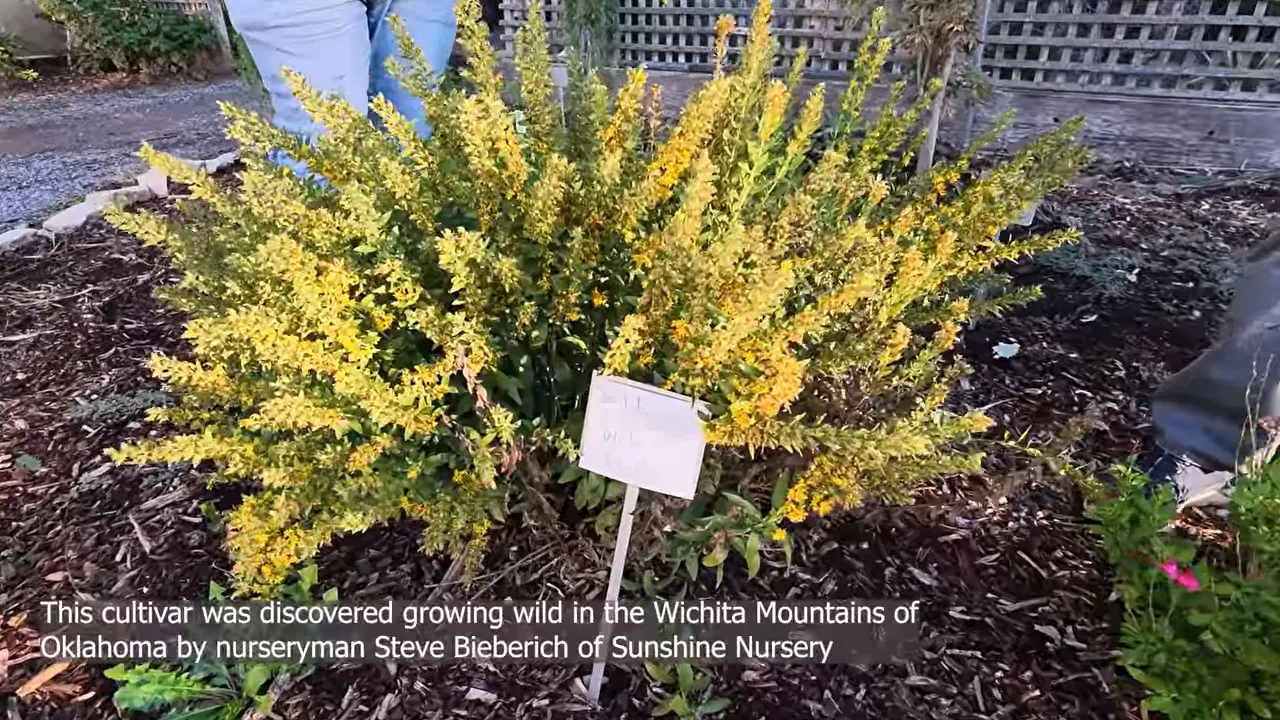
This is the sort of perennial Kadin uses for a harsh south-facing or west-facing exposure where other plants give up. It begins flowering around the first of October at the nursery, providing color late in the season.
It can spread, and extra irrigation can make the growth looser. Where that happens, Kadin recommends reducing it by about half in June to encourage a denser plant. Without that cutback, some stems can flop.
Could it work farther east? Yes, but the placement needs to make sense. Give it drainage and avoid putting it in a bed that receives frequent irrigation. Think of the difficult spot by the mailbox rather than the lush bed you water all summer. Kadin also noted successful growing experience as far north as Ames, Iowa.
Goldenrods occur across a remarkable range of habitats. The important thing is choosing the one suited to your conditions, not assuming they all want the same treatment.
‘Pink Preference’ Salvia greggii
‘Pink Preference’ is one of Sunshine’s favorite salvias. It produces spring flowers, slows during the worst heat, and comes back strongly as cooler nights return in fall.
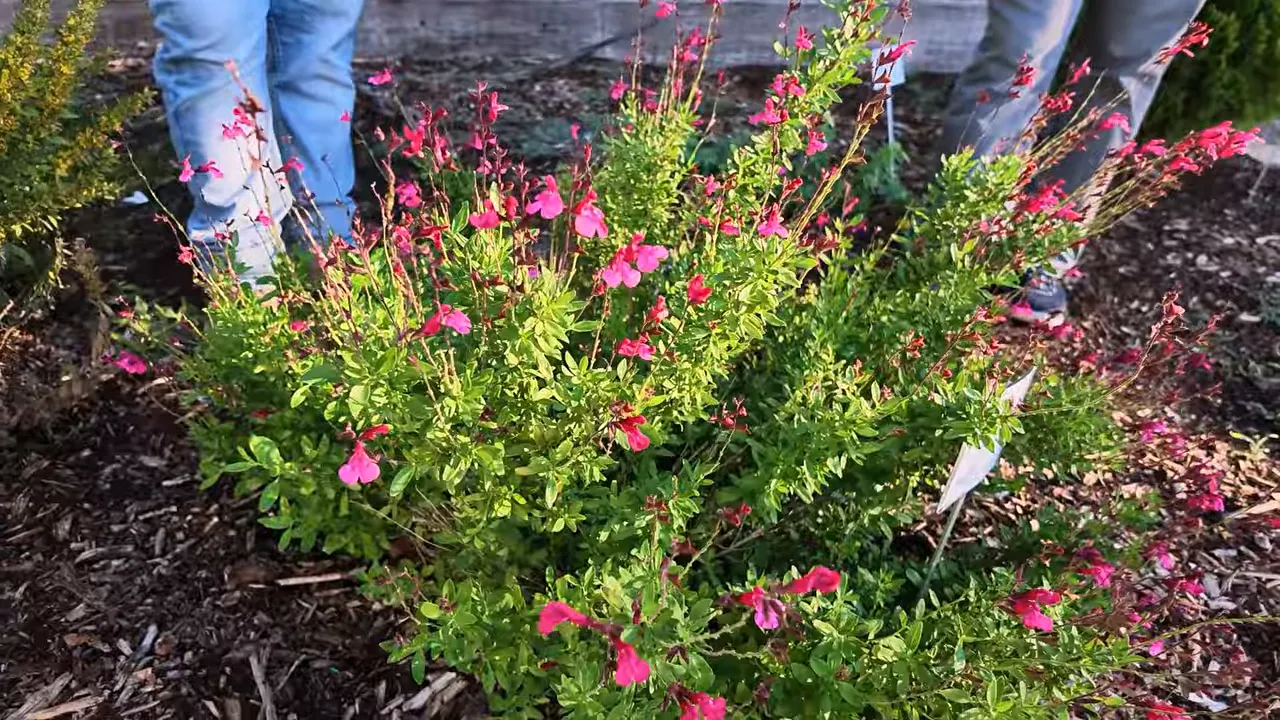
It is another plant that does not appreciate staying too wet. In production, Sunshine keeps these plants outside rather than in conditions where they receive excessive moisture.
Their maintenance routine is straightforward: cut it back to about a foot tall each spring. Left alone for three or four years, it can become large and woody, with a less attractive structure. That annual reduction helps keep it looking better.
The plant we examined was also getting some shade from a large pistachio, which accounted for its somewhat open growth. Even a tough plant responds to the amount of light it receives.
Caddo Maples: Sugar Maples With a Different Background
The dissected-leaf Caddo maple ‘Adeline’ was growing in an exposed, very dry demonstration bed. Its foliage showed the effects of the difficult summer, but Kadin pointed out that leaf quality improves as these trees establish.
Caddo maples are an isolated population of sugar maple associated with the Red Rock Canyon area of Oklahoma. As the broader forest retreated, these maples persisted under a different set of conditions, including alkaline, sandy soil.
That background makes them especially interesting. A drought-tolerant sugar maple sounds contradictory until you start looking at where the population survived.
They also bring an important seasonal habit. Kadin described trees that make their growth and then shut down rather than continuing to push vulnerable late growth. He reported survival in Bismarck at temperatures as low as minus 43°F and successful experience in Steamboat Springs, where the growing season is much shorter.
Those are observations about the material being grown, not a promise that every sugar maple will behave that way. That distinction is exactly the point.
In nursery production, their preference for drier conditions means keeping them separate from plants that need more irrigation. Grouping plants by water needs matters just as much in a garden.
Bald Cypress That Handle Alkaline Soil and Drought
Most of us picture bald cypress standing in water. Sunshine’s trees from the Frio and Guadalupe rivers in the Texas Hill Country tell a different story.
These populations grow around limestone and tolerate alkaline conditions. Kadin finds them drought tolerant, with roots that can track close to the soil surface. In Sunshine’s plantings, they also have not produced the knees that can complicate the use of bald cypress in a lawn or garden.
The contrast is not just theoretical. In nearby town plantings, Kadin has seen eastern-source bald cypress looking yellow and chlorotic beside dark green trees from the Frio population. Sometimes an existing landscape gives you an excellent side-by-side trial.
These Texas-source trees offer flexibility. They can handle wetter conditions, but they are not dependent on constantly wet ground to perform.
Using Adapted Roots to Grow More Cultivars
Here is where it gets especially exciting: Sunshine uses that adapted bald cypress material as rootstock for ornamental cultivars.
Grafting joins a selected top, called the scion, to a separate root system. If the roots can handle the soil, a cultivar that would struggle on its own roots may become a practical option.
Sunshine has been grafting selections including:
- ‘Jim’s Little Guy’
- ‘Peve Minaret’
- ‘Falling Waters’
- ‘Cave Hill’
- ‘Twisted Logic’
- ‘Gee Wiz’
In a climate with a limited conifer palette, that is a substantial opportunity. It opens the door to different sizes and forms without giving up the alkaline-tolerant root system that makes the whole thing possible.
Why Sunshine Puts So Much Effort Into Roots
The right genetics are only part of the story. Sunshine also invests heavily in root development, using a sequence of root-pruning containers rather than letting trees build a tightly circling root system.
The basic production progression is:
- Start seedlings in narrow, 2⅝-inch Anderson bands.
- Move them into one-gallon root-pruning containers.
- Continue into fabric containers or field root-control bags, depending on the finished tree.
In an air-pruning container, roots reach an opening, encounter dry air, and stop extending at that tip. Branching behind the tip creates a more fibrous system. Fabric root-control bags restrict and prune roots differently, but they serve the same broader production goal: a compact, well-branched root ball.
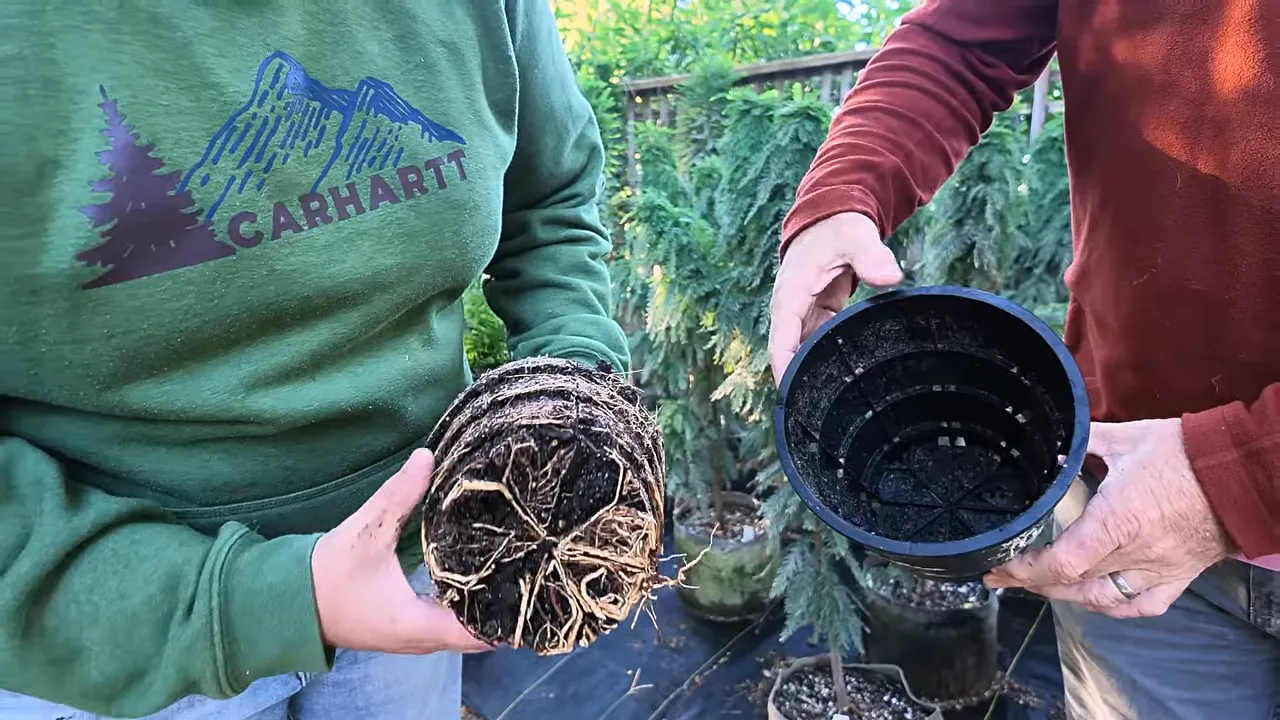
Sunshine began implementing root-control work associated with Dr. Carl Whitcomb at Oklahoma State University in the 1980s. The nursery participated early enough that some trial photographs came from its own production.
Kadin emphasizes both the fibrous roots and the reserves held in a well-developed root system. In his experience, those reserves can help a stressed tree recover, sometimes even after complete leaf loss. That is not a reason to neglect establishment watering, but it can give the plant another chance.
The system also makes a larger tree more manageable. Sunshine can finish a tree with a 2-inch trunk caliper in a 16-inch root-control bag at about 125 pounds. That is a very different handling proposition from a comparable balled-and-burlapped tree.
Other production paths finish trees in five-gallon containers at roughly 6 to 7 feet tall with a ¾-inch caliper, or move them into field production for another two years.
For the gardener, the benefit is not only convenience. Circling roots can become long-term problems, especially near the top of the root ball where a root may eventually press against the trunk. Starting with better root architecture reduces the amount of corrective work needed at planting.
The Same Oak, Different Rootstock, Very Different Results
The clearest rootstock lesson came from two examples of the hybrid oak ‘Chimney Fire’, selected by Guy Sternberg.
One was grafted onto swamp white oak, Quercus bicolor. At the end of the hard summer, it was nearly defoliated, with poor remaining foliage and little growth.
The other was grafted onto bur oak, Quercus macrocarpa. It had made noticeably better growth and retained much better foliage, despite standing in a more exposed position. The struggling tree actually had the more protected site.
The cultivar name above the graft did not explain the difference. The roots below it did.
A rootstock that performs well for a grower in Oregon may not be the right choice for an alkaline, drought-prone Oklahoma landscape. Kadin also discussed English oak, Quercus robur, as useful material for local conditions, while recognizing that graft compatibility matters.
You can sometimes locate the graft union by a change in bark texture. It is a visible reminder that a grafted tree is made from two plants with different jobs.
Nearby, Sunshine is developing a display of columnar oaks with a range of fall colors, with dwarf conifers planned in front. The narrow oak forms will provide a backdrop while allowing the nursery to observe their growth within the constraints of that particular site.
Expanding the Conifer Palette Through Trials
Sunshine’s conifer work is very much an ongoing experiment, not a finished list of guaranteed performers.
Kadin is exploring whether dwarf loblolly pine material can be paired with root systems better suited to local heat and drought. Compatibility is a hurdle. A batch of about 40 grafts from one locally found witches’ broom failed at Sunshine, while material shared with other growers produced a few successes.
He sees potential in dwarf seedlings, which may behave differently from weak-growing broom selections. The hope is to produce attractive small conifers for places where familiar options such as mugo pine have problems with heat, pine tip moth, or wet periods.
Other trial material includes Japanese black pine, Bosnian pine, jack pine, golden larch (Pseudolarix), and blue-needled Mexican pine material. ‘Uncle Fogy’ jack pine had made it through the difficult summer in full sun. Golden larch was being considered for a position with some afternoon shade.
The important word is trial. A promising summer result is useful, but it is not the same as decades of performance. Sunshine keeps moving material into the arboretum to find out what actually holds up.
Japanese Maples: Heat Tolerance Is Not Sun Tolerance
This is a distinction worth remembering anywhere you garden. A Japanese maple that tolerates Georgia heat does not automatically tolerate western Oklahoma sun.
Humidity, rainfall, wind, and exposure change how much stress a leaf experiences. Dry air and persistent wind can make a hot site much harder on foliage than a similarly warm but more humid garden.
Kadin has found Korean maples, Acer pseudosieboldianum, particularly promising, noting their thicker leaf cuticle. Hybrids involving that material expand the possibilities further.
Some Japanese maple selections also perform well, including ‘Shishigashira’ and ‘Kiyohime’. Several of the compact hime types have shown promise. Their smaller habit may be part of the advantage, though that remains an observation rather than a settled explanation.
Leaf-out timing is another selection point. A late freeze near the end of April can damage early growth. A tree needs to cope with the spring schedule as well as the summer heat.
Fall color can be unreliable, too. Some Acer japonicum selections color early enough to provide a display, but where autumn color is uncertain, good spring color and durable summer foliage become even more valuable.
Two Elm Selections Worth Paying Attention To
Sunshine has an extensive collection of native and Asian elms, and its seedling production provides opportunities to spot unusual plants.
A Variegated Prairie Expedition Seedling
One seedling from the nursery’s Prairie Expedition elm crop stood out with variegated foliage and reddish striping along the stems. It was simply sitting at the edge of a flat when Kadin noticed it.
Sunshine has made grafts and intends to call the selection ‘Sakakawea’, a reference to the Lewis and Clark connection behind Prairie Expedition’s ‘Lewis & Clark’ cultivar name. At our late-season visit, its foliage had some full-sun burn, but the combination of leaf and stem markings was still intriguing.
‘Sensation’ Golden Lacebark Elm
The golden lacebark elm Sunshine intends to call ‘Sensation’ was a real standout. At seven or eight years old, it had a dense, compact habit, much smaller than you might expect from a typical lacebark elm of that age.
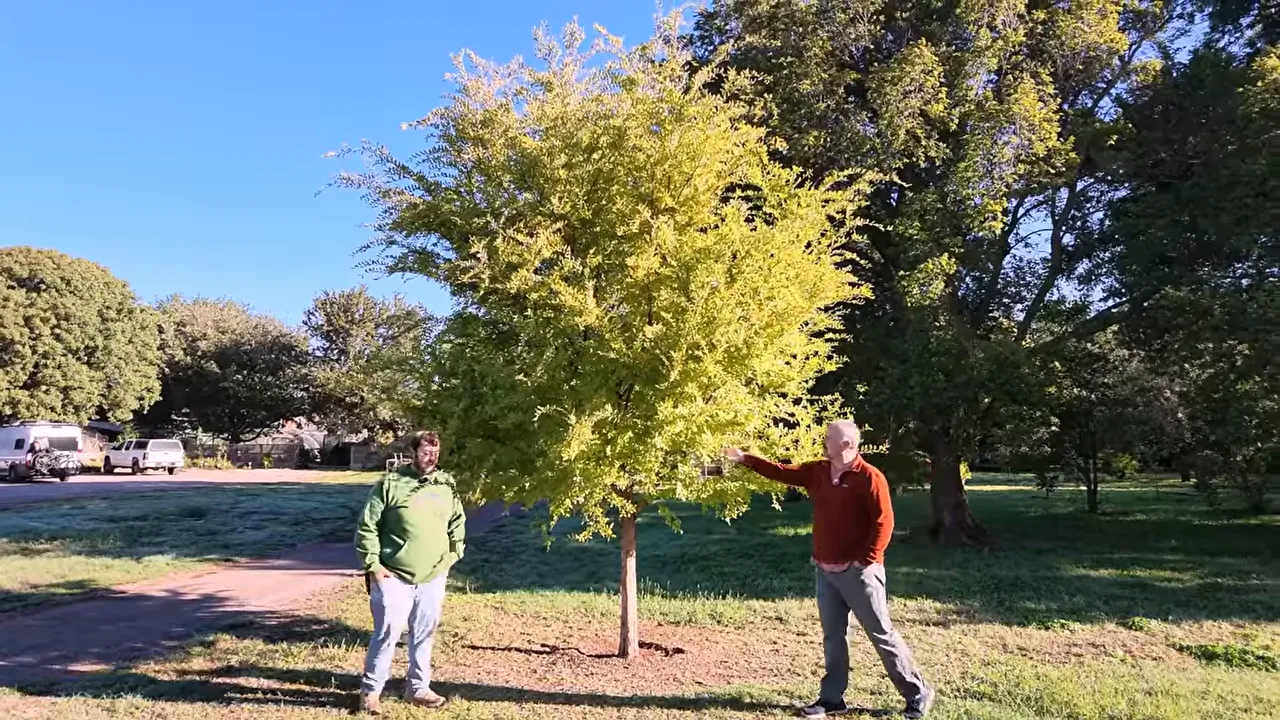
It came through the seedling crop and reached field production before its color became unmistakable. Shade cloth had muted the foliage; full exposure revealed how brilliant it could be. Kadin also described pink and red tones in the new growth.
Sunshine is propagating it by both grafting and rooted cuttings. For gardeners farther east, this is the kind of selection that could be useful in a hot, difficult location where more moisture-dependent trees struggle.
Evergreens That Push Beyond Expectations
‘Wintergreen’ Wax Myrtle
Broadleaf evergreens are a limited category in this climate, which makes ‘Wintergreen’ wax myrtle especially valuable.
Kadin says it is the only wax myrtle they have grown that survived their minus 10°F to minus 20°F episodes. That is a striking local performance record for a plant many of us associate with the South.
The foliage is also remarkably fragrant. Wax myrtles are aromatic anyway, but this one was especially strong. Between that foliage and its survival through Sunshine’s extremes, it is exactly the sort of unusual selection that long-term trials can uncover.
Arizona Cypress From Cook’s Peak, New Mexico
A planting of Arizona cypress serves another purpose: preserving genetic material from the high-elevation Cook’s Peak population in New Mexico.
Kadin reports cold tolerance around minus 20°F in this material. Preserving that provenance keeps valuable genetics in cultivation if something happens to the wild population. It also offers possibilities for extending the use of Arizona cypress into colder landscapes.
Arizona cypress is fascinating because its appearance in a harsh native site does not necessarily reveal its growth potential elsewhere. In parts of the East, I have seen it grow 3 to 4 feet in a year. A tree that looks restrained in a dry mountain habitat can become remarkably vigorous under different conditions.
Again, the species name is only the beginning. The source population can make an enormous difference.
What This Means for Your Own Difficult Garden Spots
You do not need western Oklahoma’s full collection of challenges to use these lessons. A hot driveway edge, a dry slope, an exposed mailbox bed, or a patch of alkaline soil can all benefit from more thoughtful selection.
- Understand the limiting condition. More water will not solve every chlorosis problem, and cold hardiness alone does not describe winter resilience.
- Ask about provenance. Find out whether the plant material has a record in conditions resembling yours.
- Ask about rootstock. With grafted trees, the roots may explain success or failure as much as the named cultivar.
- Look at root quality. A well-branched root system is a meaningful part of the tree you are buying.
- Separate established performance from experiments. Both are interesting, but they carry different levels of confidence.
- Match irrigation to the plants. A dryland selection may be a poor fit for a frequently watered bed.
The irrigation water at Sunshine makes the challenge especially visible. Pale mineral deposits coat containers and even nursery structures. Kadin jokes about the residue on foliage acting like ready-made sunscreen, but the larger lesson is that the water source is part of the growing environment, too.
Experimenting also requires perspective. Kadin’s good-humored rule is that you can give up after killing something three times. The useful idea behind that is not to repeat the same mistake indefinitely. It is to recognize that planting season, establishment time, exposure, and unusual weather can influence a result.
Fifty Years of Turning a Wheat Field Into Possibility
Sunshine’s arboretum began as a wheat field when Kadin’s grandfather started this work in the 1970s. The collection reflects decades of collecting, sharing, propagating, and finding out which plants survive the next unexpected weather event.
That history includes collecting trips to China, Mexico, and the Southwest, along with friendships with plantspeople such as Lynn Lowrey and J. C. Raulston. The family has had a long head start, but the trials are still very much underway.
One family story captures the enthusiasm perfectly. When Raulston returned to Oklahoma, he would visit with room in his luggage for plants. Eventually, the plants took priority over the clothes, and the clothes had to be mailed home.
That sounds about right. You can replace a shirt much more easily than an unusual plant.
What I love most about Sunshine is that a very difficult climate has become the reason for the work, not a reason to stop. The result is a collection of plants that challenges our assumptions about sugar maples, bald cypress, wax myrtles, and plenty of other familiar names. Somewhere in that diversity may be exactly the plant your difficult spot needs.


