We don’t seem to set out to collect plants. Somehow, though, we’ve ended up with a hosta collection, a Farfugium collection, and quite a few Japanese maples. Somebody will ask whether we have a particular plant, and before long I’m pointing out three or four different selections of it around the garden.
Our latest travels certainly haven’t helped that situation. Steph and I stopped at Buddy Lee’s, attended an event in Alabama, and visited Matt and Tim at Mr. Maple. We came home with unusual camellias, dwarf conifers, beautiful Japanese maples, and several other plants that we’ll now have to find room for in our Raleigh garden.
There was some garden art in the haul, too, along with cactus from our desert travels. But the outdoor plants offer plenty to get excited about, especially when you start looking at the different shapes, foliage colors, and flowering seasons they can bring to a small garden.
Key Takeaways
- Dwarf and narrow selections make unusual trees and conifers practical possibilities for a small garden.
- Japanese maples offer distinctive seasonal colors, leaf textures, and branching habits even at compact sizes.
- Summer-flowering camellia hybrids shift their display away from the frosts that damage late-winter flowers.
- Tree dahlia delivers spectacular late-season flowers, but freezing weather can cut the display short.
Table of Contents
- Japanese Maples That Fit a Small Garden
- Unusual Camellias, from Giant Leaves to Summer Flowers
- Dwarf and Narrow Conifers for Limited Space
- Hydrangeas, Evergreen Shade Plants, and Two Unusual Trees
- The Big Surprise: A Tree Dahlia Flowering in November
Japanese Maples That Fit a Small Garden
Japanese maples are hard to resist when you see a number of them together. It’s easy to imagine that the choices amount to an upright tree, a dwarf, or a weeping form. Then you start comparing leaf shapes, spring growth, fall color, and branching, and all those subtle differences become pretty amazing.
Most of our new selections should remain fairly small over the next decade. That’s an important planning window for me. I want to understand what a plant is likely to do over the next 10 to 15 years, rather than focus entirely on how large a very old specimen might eventually become.
‘Marmalade’: Reddish Orange and Lime Green
‘Marmalade’ is a Talon Buchholz introduction and one of the especially popular selections at Mr. Maple. Ours is still a small grafted plant, but it already has wonderful color.
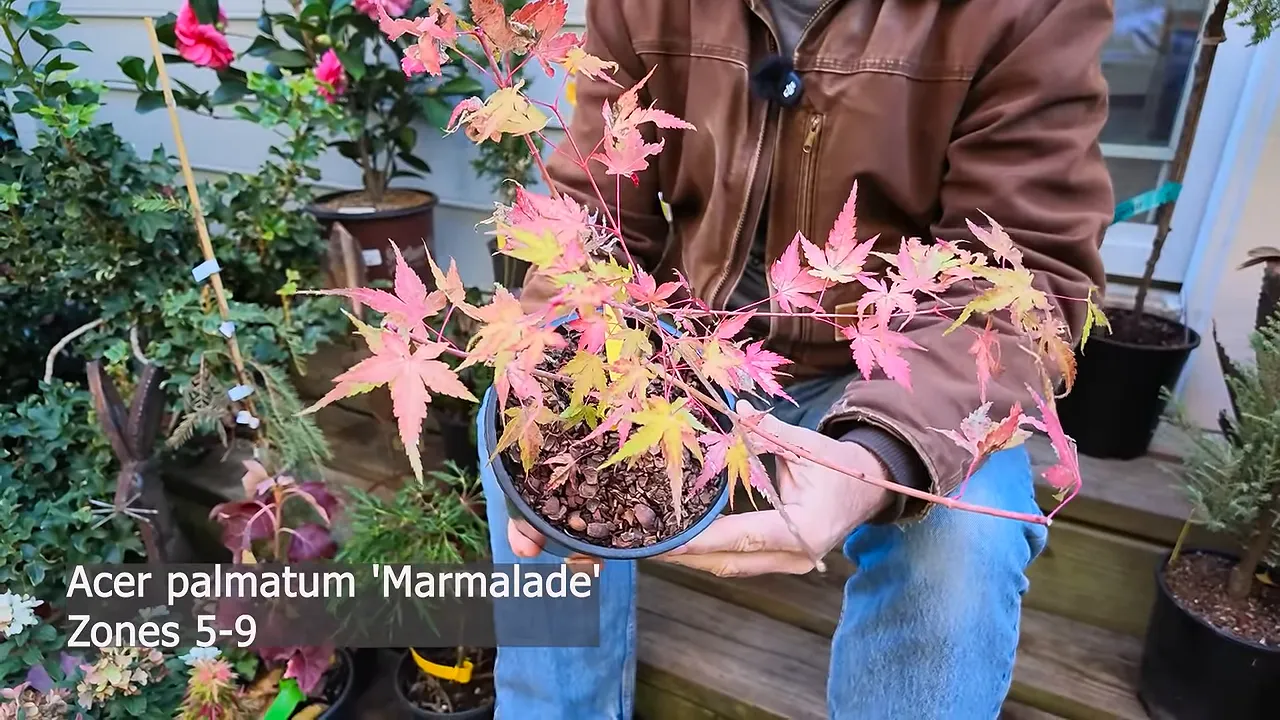
The reddish orange tones it develops in fall are similar to its spring flush. During the growing season, the foliage takes on a lime green coloration, so this isn’t a maple that gives you the same look all year.
- Approximate size: 6 to 8 feet tall in 10 years.
- Hardiness: Zones 5 through 9.
- Main attraction: A strong seasonal change from colorful new foliage to lime green summer leaves and warm fall tones.
‘Bloody Talons’: Slow Growing, but Worth the Wait
Another Talon Buchholz introduction, ‘Bloody Talons’ is a much smaller and slower-growing plant. It may reach only about 3 feet in 10 years. It isn’t the most vigorous selection, but it’s interesting enough that I’m happy to give it a place.
In spring, the leaves are green with red tips, which explains the name. By fall, those narrow leaves develop really intense color. The graft can also form a bulbous swelling that becomes a bit of an ornamental feature itself.
This is exactly the sort of unusual little plant that works in our garden: compact, distinctive, and worth getting close to.
‘Fairy Lights’: Fine Texture and a Whole Range of Fall Color
‘Fairy Lights’ is a compact Japanese maple with exceptionally fine-textured foliage. In spring, its green leaves have yellow coloring that seems to radiate outward from the point where the leaf stalk meets the blade.
Its fall color develops a little later, but when it arrives, it’s difficult to assign it a single color. There are yellows, oranges, and reds, often mixed in an interesting mottled effect.
At roughly 3 feet in 10 years, this is another selection we can work into a very small space without giving up that wonderful Japanese maple character.
‘Kryptonite’ and the Appeal of ‘Mikawa Yatsubusa’
We already have several selections related to ‘Mikawa Yatsubusa’, including ‘Snow Kitten’ and ‘Red Panda’. ‘Snow Kitten’ has held its variegation right through summer and into fall in our garden. Its slightly warmer location has also kept it looking active later into the season.
Our new addition, ‘Kryptonite’, has creamy white spring variegation and the compact habit that makes this group so useful.
There’s something about ‘Mikawa Yatsubusa’ that makes it a Japanese maple enthusiast’s Japanese maple. The naturally sculptural growth can look as though somebody has already spent years training it as bonsai.
That doesn’t mean these plants stop growing forever. We’ve seen an enormous old ‘Mikawa Yatsubusa’ at Buchholz Nursery. But for the scale and time frame of our garden, these compact forms give us a great deal of character without immediately becoming large trees.
‘Olsen’s Red Mini’: Colorful Leaves and Stems
‘Olsen’s Red Mini’ has similar bright coloration in spring and fall, with foliage that settles into a more maroon tone during summer. Even the stems have good color.
Its expected size is about 3 feet tall and wide in 10 years, making it another useful little shrub-sized maple.
Many of these selections are listed for Zones 5 through 9, although it’s important to check the individual cultivar. Their cold hardiness gives us some flexibility here in Raleigh. We can try them in containers, leave suitable plants in those containers over winter, or temporarily plant them into an available garden bed while we decide on a permanent location.
‘Mila’: One That Needs More Room
‘Mila’ is the exception to our mostly small-growing maple haul. It may reach around 12 feet in a decade, so it needs a location where we can allow it to become a larger plant.
Its spring growth echoes the colorful appearance it has in fall, while the foliage becomes more maroon during summer. It’s also still relatively uncommon in the nursery trade.
I’m excited to have it, but this one will require a little more thought than simply finding another small opening between existing plants.
‘Grumpy’: Another Compact Addition
Matt and Tim have a Seven Dwarfs series, and we brought home ‘Grumpy’. It’s another very compact selection, with a lively mix of foliage colors.
That’s how the collection keeps growing. Each plant has some little difference that makes it feel entirely justified.
Unusual Camellias, from Giant Leaves to Summer Flowers
Camellia gigantocarpa: Big Leaves, Big Flowers, and Giant Fruit
One of the plants I’m most excited about came from Buddy Lee, the inventor of Encore Azaleas. It’s a species camellia called Camellia gigantocarpa.
The leaves are about the size of my hand, and the flowers are large, too. Our plant still had one fading white flower when we got home. Bees are very interested in these flowers when they’re open.
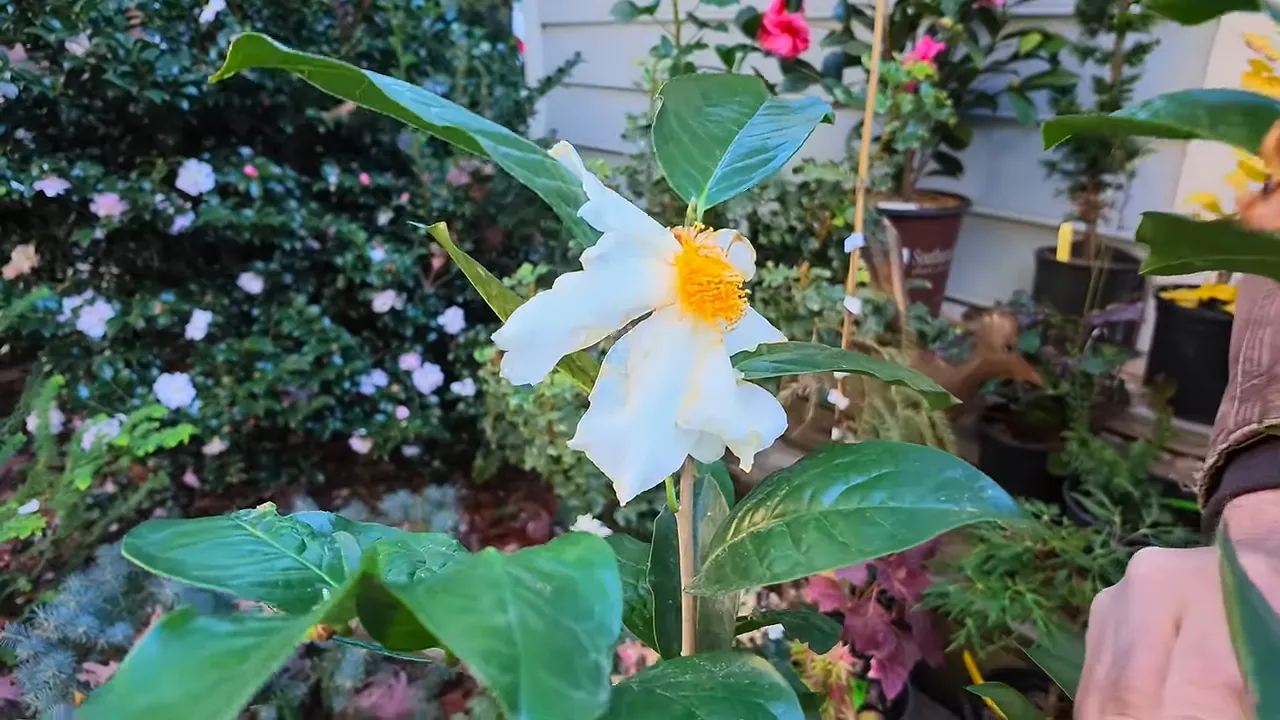
One of this species’ most remarkable characteristics is its fruit, described as the largest of any camellia. The seeds are notoriously difficult to germinate, but Buddy had successfully grown three seedlings.
Seedlings can differ quite a bit in their growth habit. Some are broad, while others are more upright. The one we brought home has a strongly upright, narrow habit, which is what made it possible for us to consider it.
A plant with “giganto” in its name doesn’t necessarily sound like the obvious choice for a small garden. Choosing the right individual plant can make all the difference. We have several species camellias, but we have to be selective about width.
Summer- and Early Fall-Flowering Camellias
We also brought home two examples of some really exciting camellia breeding: hybrids that flower in summer and early fall. One is called ‘Early Surprise’. The other hadn’t yet been given a name that I knew.
These hybrids bring together familiar camellia types, including japonicas and sasanquas, with additional species breeding to produce a very different flowering season. Their flowers can have the look people associate with Camellia japonica, but without being restricted to its usual late-winter and spring display.
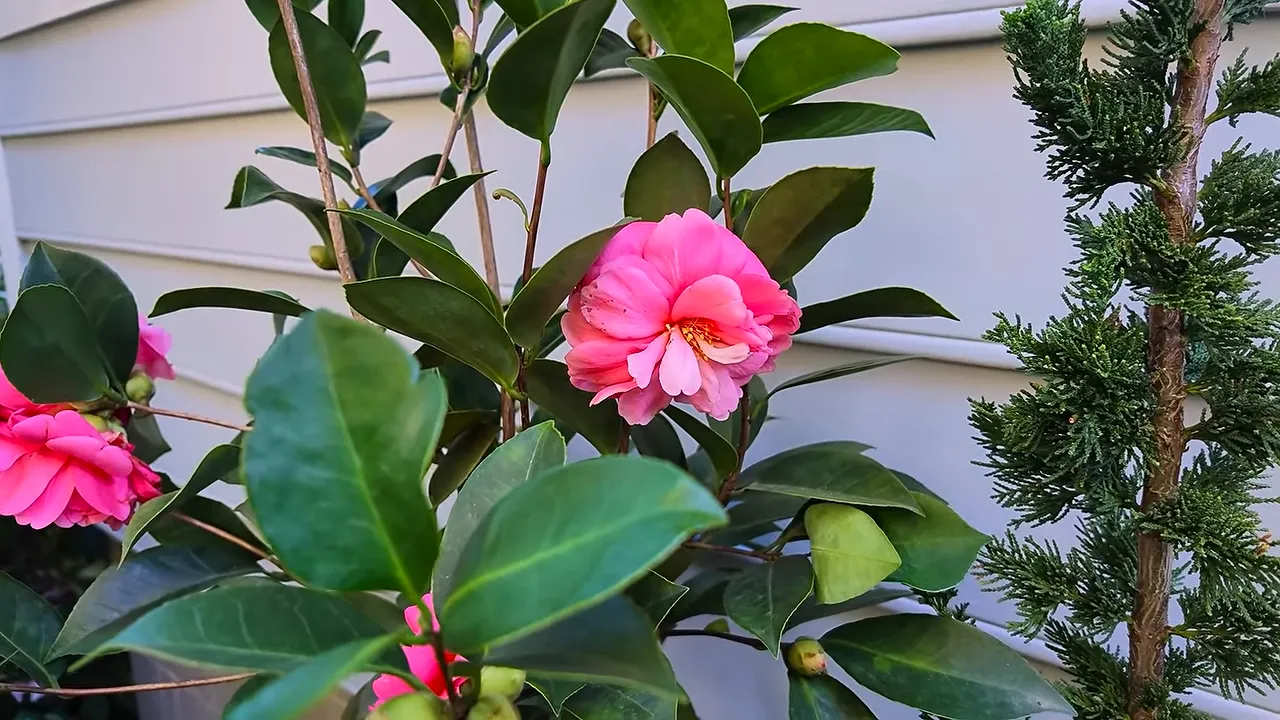
Here in Raleigh, japonicas commonly flower in February and March, with bloom extending into April. Some years are wonderful. Other years, it seems as though every flower opens just in time for another frost to damage it.
Moving flowering into summer and early fall takes that particular problem out of the equation. We saw these new hybrids in full flower at a show in the middle of July.
There’s a practical benefit for nurseries, too. When I grew camellias, much of their flowering happened during the quiet winter sales season. By the time most customers were shopping, the plants were green shrubs, and a picture tag had to explain what the flowers would eventually look like. A camellia in full bloom during the fall shopping season is a very different proposition.
That doesn’t diminish the wonderful fall-flowering sasanquas already available. Our ‘October Magic Orchid’, one of Bobby Green’s introductions, is coming into bloom with its beautiful pink and white flowers. These new hybrids simply add another exciting possibility.
Dwarf and Narrow Conifers for Limited Space
Steph and I love visiting the giant conifers of the West Coast. Bringing that interest home to a small Raleigh garden means looking for dwarf selections, narrow forms, and plants with unusual branching.
It also means being realistic about climate. Cold hardiness and summer heat tolerance aren’t the same thing. A plant labeled for Zone 8 may perform well in Portland without being equally comfortable in the Southeast. The USDA Plant Hardiness Zone Map is a useful starting point, but it doesn’t tell the whole story of a growing location.
A Very Slow-Growing Thuja occidentalis
One of our smallest additions is an extremely slow-growing selection of Thuja occidentalis, the arborvitae species that includes familiar cultivars such as ‘Emerald Green’ and ‘DeGroot’s Spire’.
The species comes from cooler northern regions, and it isn’t my first choice for a hot, exposed location here. But we’ve had good success with some dwarf selections when we place them where they aren’t getting blasted by sun all day.
This new one should remain only a few feet tall over a decade and very narrow. I chose an individual with a little extra branching, although many of the plants were almost completely vertical.
A tiny plant like this can look unfinished in its nursery container. In reality, it may have occupied that pot longer than a much larger camellia nearby. Its size is a reflection of how slowly it grows, not necessarily how recently it was propagated.
‘Bonsai’ Dawn Redwood
We brought home a dwarf Metasequoia called ‘Bonsai’. Instead of developing into the enormous tree associated with dawn redwoods, this selection is expected to remain just a few feet tall in a decade.
It’s a deciduous conifer, so it won’t provide evergreen foliage through winter. What it does offer is a way to enjoy a fascinating tree on a much smaller scale.
‘Daub’s Frosted’ Juniper on a Standard
‘Daub’s Frosted’ juniper is a plant we’ve enjoyed in different forms over the years. This one is raised on a standard, giving us room to plant lower-growing things beneath its head.
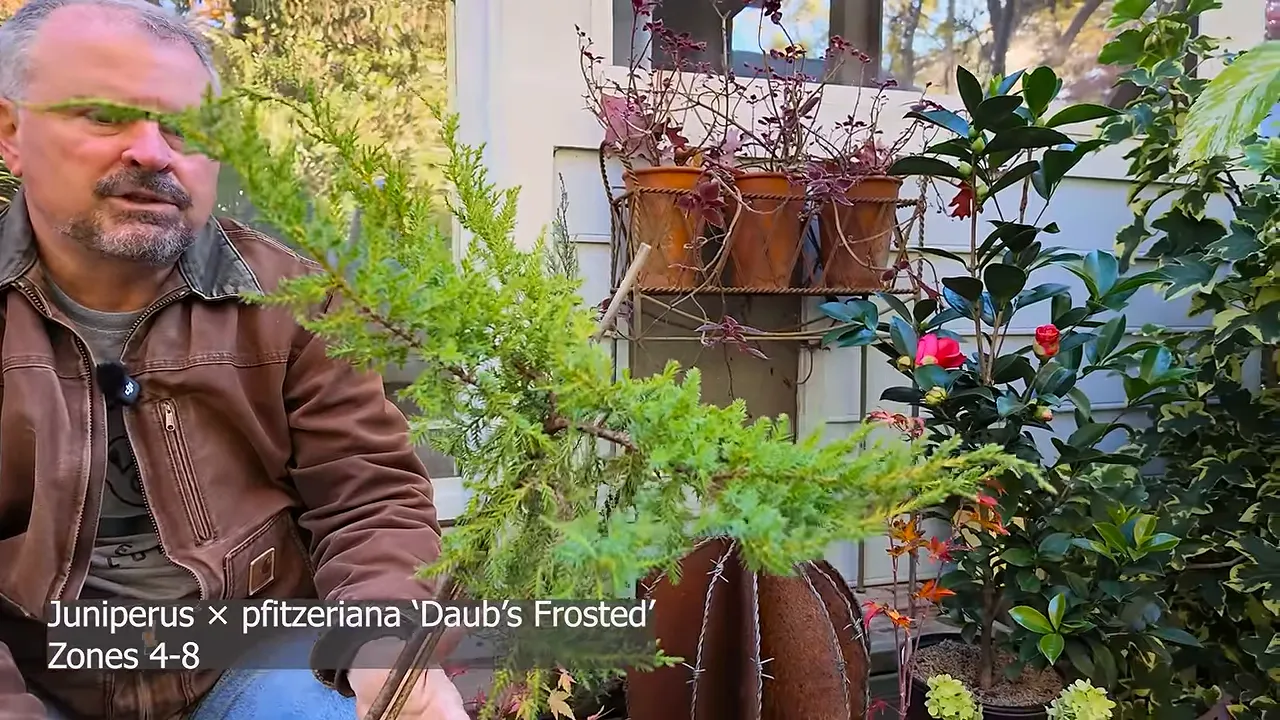
During active growth, it develops gold to chartreuse new foliage. That effect is less obvious in November, but it’s a big part of the plant’s appeal during the growing season.
We can prune the head to keep it relatively tight. It would also make an interesting container plant, particularly with something spilling over the pot’s edge underneath it.
If you’re nervous about trying ornamental conifers, junipers are often among the tougher choices. Some of the conifers we experiment with in the South can be finicky about climate, but junipers are generally rugged plants.
‘Blue Surprise’ Lawson Cypress
Chamaecyparis lawsoniana grows into immense trees in its native range in Oregon and Northern California. Fortunately, there are many selections that behave very differently.
‘Blue Surprise’ has beautiful blue-green foliage, almost the sort of blue you might associate with a desert plant. Its narrow form is particularly useful here: approximately 6 feet tall and only 2 feet wide in 10 years.
It also has somewhat better heat tolerance than the other Lawson cypress we brought home. With this species, paying attention to the individual selection matters.
‘Wissel’s Saguaro’: A Conifer with Arms
‘Wissel’s Saguaro’ has the upright, narrow shape we need, but with short branches that eventually project from its sides like the arms of a saguaro cactus.
If you’ve spent time around Tucson or Phoenix, you know that a saguaro with arms is not a young cactus. It takes a long time to develop that character. This conifer gives us an interesting echo of that form in a completely different kind of plant.
Many unusual conifer selections begin with odd growth on much larger trees. A dense, bunchy patch of growth called a witches’ broom can provide material for a compact cultivar. Those peculiar little branches are part of how gardeners end up with such a broad range of dwarf and unusual forms.
Hydrangeas, Evergreen Shade Plants, and Two Unusual Trees
‘Pee Wee’ Oakleaf Hydrangea
‘Pee Wee’ is a dwarf selection of our native oakleaf hydrangea, Hydrangea quercifolia. I rooted and grew it for years at the nursery, so there’s some personal fondness involved in bringing one home.
We’ve lost a couple of other dwarf oakleaf hydrangeas over time, either to deer damage or because the selections weren’t particularly strong growers. ‘Pee Wee’ was a reliable grower for me, and I wanted it represented in this garden.
Groundbreaker Hydrangeas for a Front-Garden Redesign
We were also sent Groundbreaker hydrangeas: Ruby, Blush, and Greeny. Their eventual locations are still being worked out.
We’re beginning a redesign of the bed directly in front of the house. Some existing plants may move into our neighbor’s garden, where we’ve already started preparing the space with wood chips. That could open up room for these hydrangeas in our front garden.
Beesia for Evergreen Interest in Shade
Beesia is an evergreen perennial with white flower spikes and a slow, clumping habit. It’s a useful possibility for part shade to shade, especially where we want something that won’t disappear completely during winter.
The new foliage has a burgundy coloration before developing into green leaves with slightly lighter veins. It isn’t in any hurry to take over the garden, which is another point in its favor here.
Our shaded spaces can look pretty stark when all the herbaceous perennials die back. Plants such as Beesia, cast iron plants, and epimediums that retain foliage help keep those areas interesting.
‘Beijing Gold’ Ginkgo
We already have a dwarf ginkgo near the front fence. Our new one, ‘Beijing Gold’, is a variegated, non-fruiting selection with a somewhat narrow form. I’m expecting a plant around 10 feet tall, rather than a broad tree that immediately overwhelms its neighbors.
When choosing a ginkgo for a garden like ours, I definitely prefer a non-fruiting selection. The fleshy covering around the seeds has a famously unpleasant smell.
Ginkgos are fascinating plants with an ancient history. Having a smaller, unusual foliage selection gives us another way to include that interest in the garden.
A Variegated English Elm
One final addition from Matt and Tim is a variegated English elm. Its leaves are beautiful, but this is not another tiny shrub-sized plant.
I’m thinking in terms of roughly 20 to 25 feet within a reasonable planning period, with the understanding that it can grow larger over time. It may become part of the front-garden redesign, although I haven’t settled on a spot yet.
That’s where shape becomes so important. We’ve lost a few plants during a difficult drought year, and we can usually find a little additional room by combining upright plants with lower-growing ones. It isn’t simply a matter of squeezing more plants in at ground level. It’s about using the different layers of the garden.
The Big Surprise: A Tree Dahlia Flowering in November
The plant that may have given us the most excitement when we returned home wasn’t from this latest trip. Earlier in the year, we visited our friends Chris and Rebecca at Historic Columbia in Columbia, South Carolina. They sent us home with Dahlia imperialis, commonly called tree dahlia.
This thing can grow 10 to 20 feet in a single season. Ours wasn’t staked quite as well as it could have been, but it’s still about 7 feet tall and absolutely loaded with flower buds.
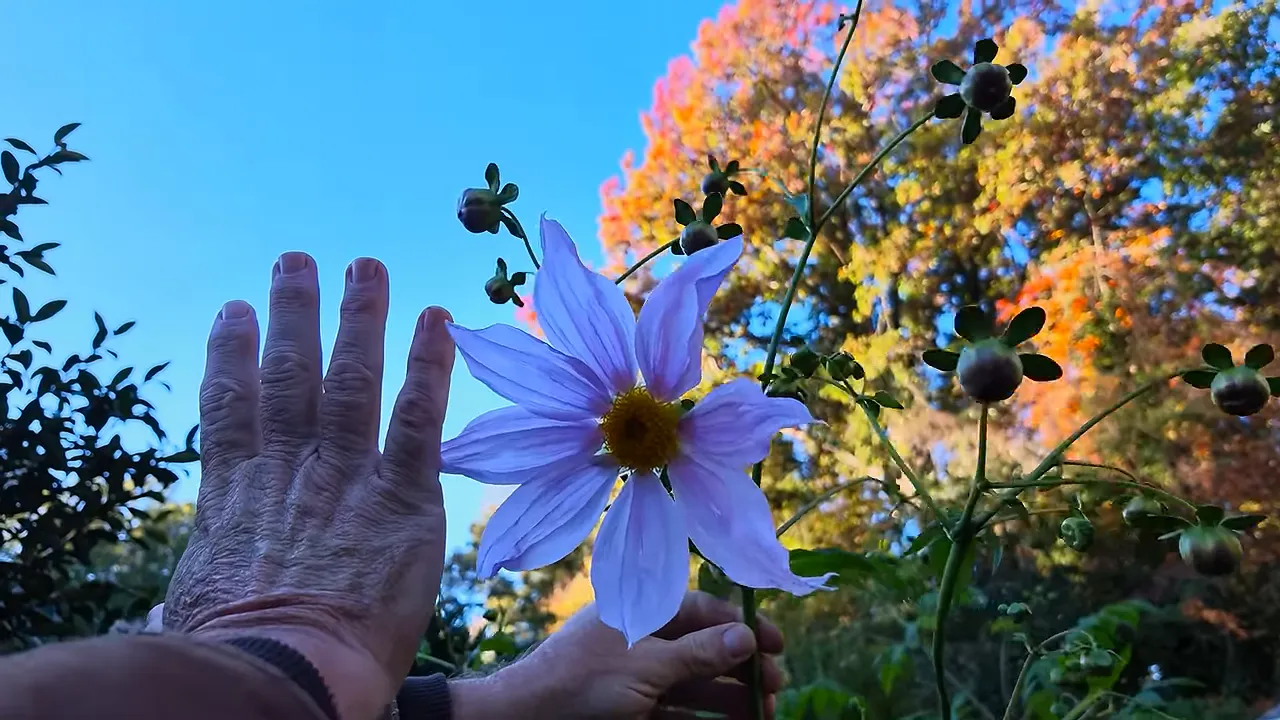
The large lavender-pink flowers are spectacular. The challenge here is timing: it begins flowering late enough that a heavy freeze can arrive just as the display gets started.
Tree dahlia is generally listed for Zones 8 through 11. In our garden, its late bloom means that one year could be wonderful while another year’s flowers might be cut short by temperatures in the mid-20s.
We had a night around 32 degrees Fahrenheit just as it was coming into flower. There was a little ice on the car windows, but the garden showed no obvious damage. The mulch and wood chips help the ground retain warmth longer, and the garden’s conditions were clearly different from those exposed surfaces.
With the next stretch of nights forecast in the middle to upper 30s, we had a good opportunity to enjoy more flowers. Whether it returns after winter is another question. Even a favorable Zone 7 location might get one through the right winter, but cold and wet conditions after it dies back could change the outcome.
For now, I’m simply enjoying it. We brought home a small plant from a memorable visit, and a few months later it became one of the most striking things in the garden. That’s a pretty good reason to keep making a little room for something unusual.


