Fall garden cleanup is not about taking everything down to bare ground. Some plants need to come out, some need leaves lifted off them, and some are best left alone until spring. The trick is knowing which job belongs where.
We came home from a month-long trip out west to fallen leaves, tired annuals, and the first little pockets of frost in our Raleigh garden. Stephanie, her son Miguel, and I started with the work that mattered most: removing plants that were finished, uncovering low-growing plants, and clearing space for the next round of planting.
There is plenty left to do, including spring-flowering bulbs, fresh wood chips in the paths, and mulch in the beds. But this first pass is about protecting what is already here without cleaning away everything that makes the garden useful to wildlife.
Table of Contents
- Key Takeaways
- Let Frost and Plant Condition Guide Annual Removal
- Leave Leaves, but Do Not Let Them Bury Plants
- Be More Selective About Self-Sown Annuals
- Give the Empty Vegetable Garden a Winter Job
- Do Not Give Every Perennial Bed the Same Cleanup
- Clear Space Now for Bulbs, Mulch, and Winter Projects
- A Little Help With the Heavy Work
Key Takeaways
- Remove tired annuals as frost finishes them, rather than clearing useful flowers on a fixed date.
- Keep leaves in the garden without allowing deep piles to bury small conifers and ground covers.
- Leave native perennial stems and seed heads standing to support overwintering insects and birds.
- Use cleared vegetable beds to overwinter plants awaiting permanent positions in the garden.
Let Frost and Plant Condition Guide Annual Removal
The forecast does not have to say 32°F for frost to show up in the garden. Our overnight low was predicted to be about 37°F, yet there was a little frost on cars, rooflines, and a few plants the next morning. With lows around 34°F to 35°F expected next, more scattered frost seemed likely even though a widespread freeze was not in the forecast.
That is why I pay attention to what is actually happening around the garden, not just the temperature on the weather app. Different spots can behave differently.
We had deliberately left the annuals in place past their best-looking stage. Before we left, pollinators were still active, and hummingbirds were still visiting. A plant does not have to look perfect to keep doing something worthwhile.
But once a couple of frosts hit tender annuals such as vinca, begonias, and impatiens, they can turn into a soft, collapsed mess. At that point, we start taking them out rather than leaving them to deteriorate in the beds.
Keep useful flowers as long as they are useful, then remove the annuals when frost and decline finish the job. That is a more practical approach than clearing everything on a particular date.
Leave Leaves, but Do Not Let Them Bury Plants
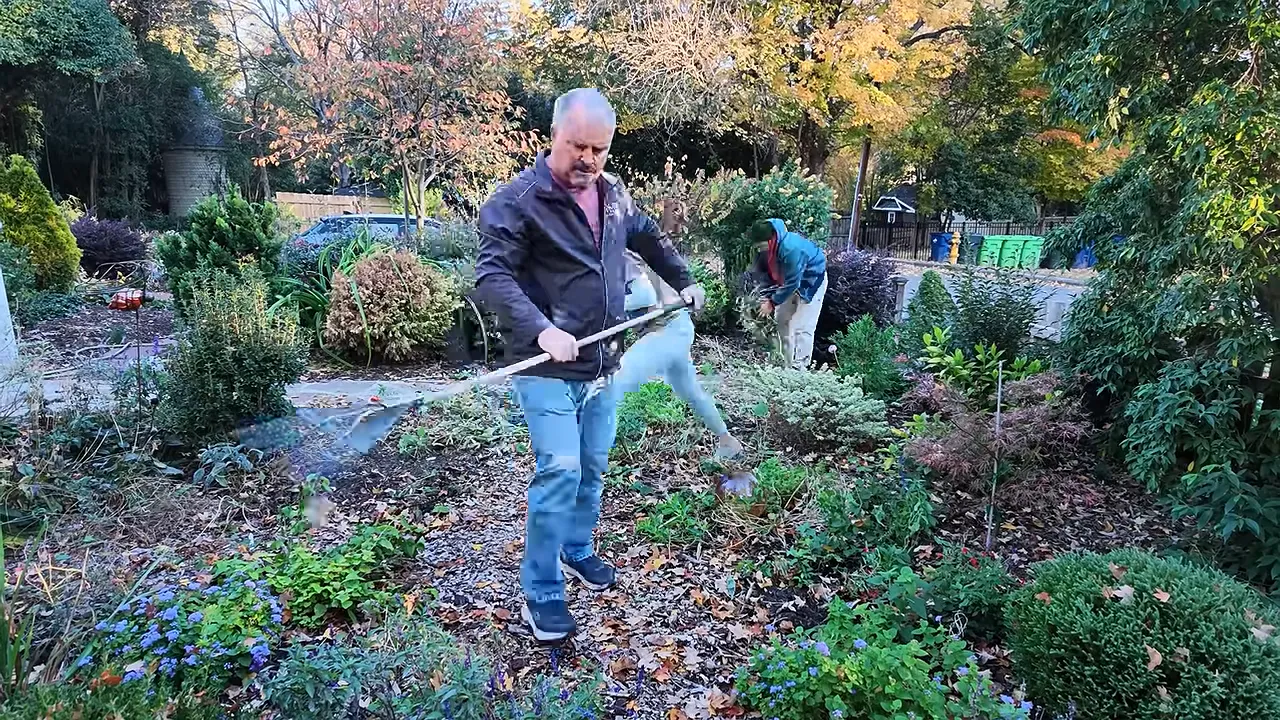
One of the most important jobs right now is simply getting leaves off plants that cannot handle being buried.
We leave a lot of leaves in this garden. But there is a large white oak over the back corner, and it produces more leaves than that space can reasonably hold. There is a limit, especially when the beds contain small conifers, ground covers, and other low-growing plants.
A deep accumulation can cover those plants for the winter, leaving them struggling underneath and potentially encouraging rot. Leaving leaves is worthwhile, but it does not mean ignoring where they land.
On this first cleanup pass, we are concentrating on:
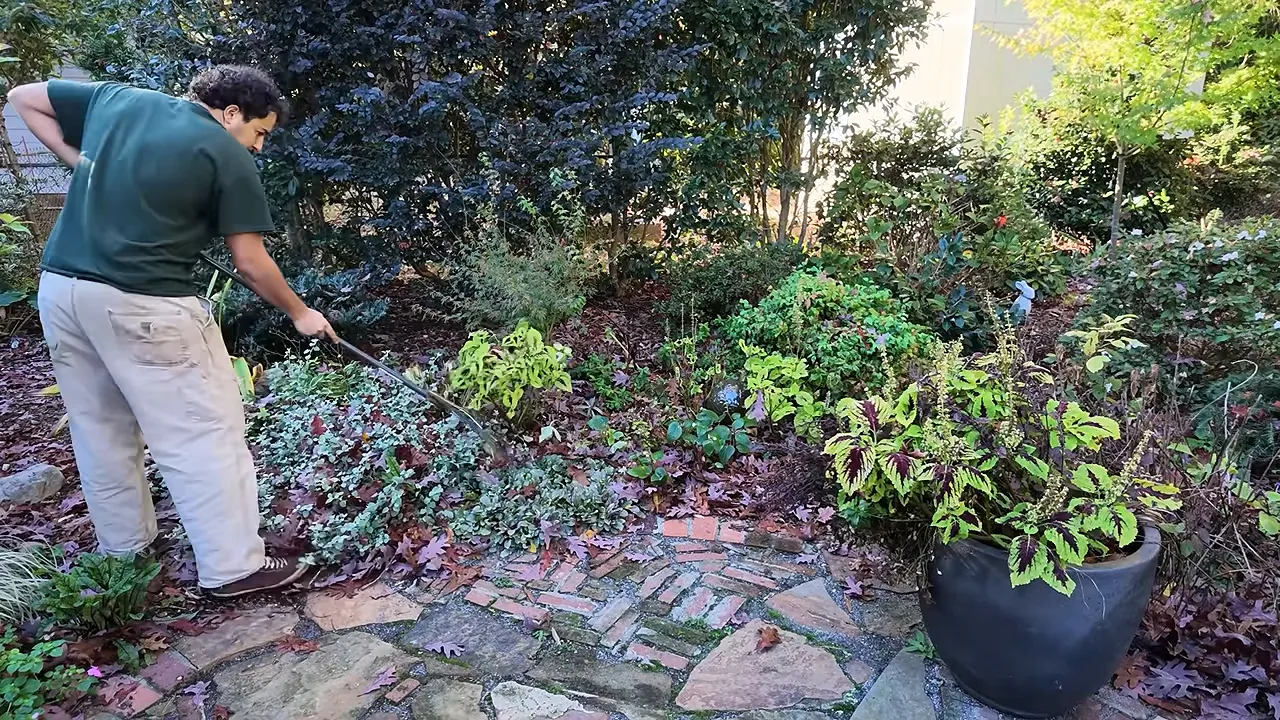
- Small conifers: lifting leaves out of and off the foliage.
- Ground covers such as Sarcococca: uncovering plants where leaves have piled too deeply.
- Other low-growing ornamentals: checking that they have not disappeared beneath the leaf fall.
- Paths and paved areas: moving leaves so we can get around and prepare for upcoming work.
Not all the leaves have fallen yet, so this will take more than one visit. I would rather make a few targeted passes than wait until every leaf is down while small plants sit buried underneath them.
Reuse Some of the Leaves as Mulch
Leaves can also go right back into the landscape in a more manageable form. Stephanie suggested gathering them in the driveway, shredding them with a mower, and returning the shredded material to the beds as mulch.
That gives us another option besides either removing every leaf or leaving every leaf exactly where it falls. We can keep useful material in the garden while moving excess away from vulnerable plants.
For more background on the wildlife value of leaf litter, the Xerces Society’s guidance on leaving the leaves is a useful companion to this approach.
Be More Selective About Self-Sown Annuals
Celosia has become one of the plants we need to get under better control.
We have planted several different celosias over the past few years, and practically all of them seem to have left offspring behind. In spring, it is easy to spot a little seedling and think, “That will be nice. More flowers.” Then it gets tall, crowds its neighbors, and produces another generous crop of seed.
They have become bullies in this garden. That does not mean celosia is a bad plant. It means we have been too willing to let every volunteer stay.
Some vinca, impatiens, and a few other annuals also reseed here, but those have been easier for us to recognize and remove early. The celosia needs a firmer hand.
A volunteer plant still needs to earn its space. If it is going to overwhelm the plants around it, keeping it just because it appeared for free is not doing the garden any favors. Part of this fall cleanup is recognizing where we need to be more selective next spring.
Give the Empty Vegetable Garden a Winter Job
We also removed the last of the summer vegetables and cleaned up that space.
We used to grow a fall vegetable garden, and I do miss it. Coming home to lettuce and leafy greens would have been wonderful. But we have traveled more during the fall over the last three years, so a fall crop has not fit our schedule very well.
One possibility is growing some greens indoors on our light rack. We mainly use that rack for spring seed starting, so it is available much of the rest of the year. That is an option we are considering, not something we have already put into practice.
For now, the vegetable garden has another purpose: holding plants in the ground over winter while we decide on their permanent homes.
Miguel planted a collection of native perennials there while Stephanie and I worked on removing the fencing we had used to keep rabbits out of the vegetable garden. Those perennials can spend the winter in the bed, then move into the native planting in spring.
It is a useful reminder that an empty vegetable bed does not have to sit unused. In our case, it is temporary planting space for plants we have collected but have not quite placed yet.
Do Not Give Every Perennial Bed the Same Cleanup
The ornamental garden and the native garden are getting very different treatment this fall.
In the main ornamental beds, the spent annuals are coming out completely. We are also cutting back some of the rougher-looking non-native perennials. That is selective tidying, not a plan to cut every perennial to the ground.
In the native garden, we are leaving the perennials standing.
Keep Seed Heads and Stems for Wildlife
The agastache is a good example. It still has seed heads, and we are seeing bird activity around it. Some of those seed heads will continue to provide food for birds spending the winter here in Raleigh.
Some native insects also overwinter in perennial stems. Cutting everything down now would remove material that is still serving a purpose.
The same goes for the leaves on the ground in that area. Through winter, birds will turn them over looking for food. We had a fox out there that morning digging around for insects, worms, or beetles, and raccoons also come through searching for something to eat. The raccoons can do a little more digging than we would prefer, but the activity tells us that the garden is supporting more than plants.
By the standards of a very tidy ornamental garden, this space may look messy in winter. I am fine with that. There is a reason for leaving it alone.
Low Maintenance Still Requires Some Attention
Leaving the native garden standing through winter does not mean it will never need maintenance.
Some perennials may spread or turn up a little farther from where we remember planting them. They may wake up in a different neighborhood from the one where they went to sleep. We will need to manage that movement so we can keep a good variety of plants in the space.
We also have Chinese privet trying to regrow after being cut down. That will need continued attention. And in spring, there may be a stray stem or branch to remove and a little selective cleanup to do.
For winter, though, the plan is simple: refresh the wood chips in the paths and otherwise leave the planting largely alone. Enjoy the birds. Enjoy the creatures using it. Resist the urge to make every part of the garden equally tidy.
Clear Space Now for Bulbs, Mulch, and Winter Projects
This first cleanup makes the next jobs much easier.
Our spring-flowering bulbs have shipped, and many will go into spaces currently occupied by annuals. Removing those annuals now gives us room to plant when the bulbs arrive.
We also lost a few plants during a terrible drought year. Those will need to come out, and we will look more closely at those losses as we work through the garden.
The remaining winter preparation includes:
- Planting spring-flowering bulbs in the newly opened spaces.
- Getting more plants into the ground, either permanently or in the vegetable garden for winter.
- Emptying spent containers as we work through the seasonal change.
- Adding fresh wood chips to paths once the initial clearing is done.
- Mulching the ornamental beds after the leaves finish falling.
We are also beginning work in the neighbor’s front garden as a separate project, including soil testing and wood chips. Keeping those projects distinct helps us work through each space without treating everything as one enormous cleanup job.
And the fall garden is not finished flowering just because cleanup has started. We came home to camellias, tree dahlia, Dahlia imperialis, and other plants in bloom. There is still plenty to enjoy while we make room for the next season.
A Little Help With the Heavy Work
Miguel has started a Raleigh-area landscape company called Dead Yard Revival, and we were glad to have his help with this first round of work.
His work includes planting, mulching, sod installation, making beds, leaf cleanup, and some demolition work. Seasonal gardening jobs such as pruning, planting, and fertilizing are part of that work as well.
Leaf handling alone can be a substantial job, especially for households that have relied on city leaf vacuuming. Help can mean gathering and removing excess leaves, or shredding them and returning them to the landscape where they can be useful.
That is really the goal of this whole first pass: remove what is finished, protect what could be damaged, and leave what still has a job to do. Getting the garden ready for winter does not have to mean cleaning all the life out of it.


