Compacta Japanese holly shows up on an awful lot of foundations. It has small, rounded leaves without prickly points, it is reasonably tough, and it makes a familiar green mound. But its popularity has as much to do with nursery production and construction budgets as it does with being the best plant for the spot.
Compacta hollies are easy to root, easy to grow, and typically inexpensive. When a new house needs a certain number of shrubs to meet local landscaping requirements, inexpensive plants tend to win. That does not necessarily leave the homeowner with the most interesting landscape, or the easiest one to maintain.
These hollies commonly reach about 4 to 6 feet tall. Put them below low windows, and eventually you are pruning, pruning, pruning to keep the glass clear. There are plenty of alternatives that offer a smaller habit, better foliage color, flowers, a different texture, or a better fit for difficult conditions.
Key Takeaways
- Choose foundation shrubs by available height, width, sunlight, and moisture rather than purchase price alone.
- Compact shrubs can still outgrow their tags, so distinguish natural size from a maintained size.
- Mix foliage colors and textures to create interest beyond a uniform row of green hollies.
- Plant diversity reduces dependence on one shrub’s ability to withstand pests, disease, and difficult weather.
Table of Contents
- Choose the Plant for the Space, Not Just the Price
- Dwarf Loropetalum for Purple Foliage or White Flowers
- Compact Nandinas for Red, Burgundy, or Chartreuse Color
- Abelias for Variegation, Summer Flowers, and Pollinators
- Clean Sweep Snowbank Indian Hawthorn for Low Windows
- Gardenias and Azaleas for More Flower Power
- Other Hollies That May Fit Better Than Compacta
- Boxwoods for Formal Shape and Deer Resistance
- Colorful Broadleaf Evergreens for Sun or Shade
- Osmanthus for Variegation, Fragrance, and Flexible Shaping
- Conifers for Soft Texture and Year-Round Structure
- Soft-Textured Shrubs for Shade and Dry Shade
- Viburnums for Flowers, Fruit, and Changing New Growth
- Build a Foundation Planting That Does More
Choose the Plant for the Space, Not Just the Price
The best replacement for Compacta holly is not the same shrub in every yard. A hot brick foundation, a shady bed under established trees, and a moist north-facing wall are three different planting situations.
Before choosing a replacement, sort out a few things:
- Available height: A shrub beneath a 3-foot-high window needs to be different from one anchoring a corner with 6 feet of clearance.
- Available width: Many low-growing shrubs spread considerably wider than they grow tall.
- Sun and moisture: Dry shade and wet shade are not interchangeable, and neither is the same as a sunny foundation.
- Maintenance expectations: A plant that can be maintained at 2 feet is not necessarily a plant that naturally stays 2 feet tall.
- Local conditions: Check the cultivar’s suitability for your climate, including your USDA plant hardiness zone.
Plant tags are useful, but plants do not read them. Several shrubs below can eventually exceed their commonly listed dimensions. I would rather account for that at planting time than spend the next twenty years fighting the plant.
Dwarf Loropetalum for Purple Foliage or White Flowers
Cerise Charm and Purple Daydream
Dwarf loropetalums give you something very different from a green holly ball. Cerise Charm has rich purple foliage throughout the plant and the characteristic fringed flowers. In our Raleigh, North Carolina, garden, the main flowering season is generally March or April, with scattered repeat flowers later. Ours was even carrying a few flowers in October.
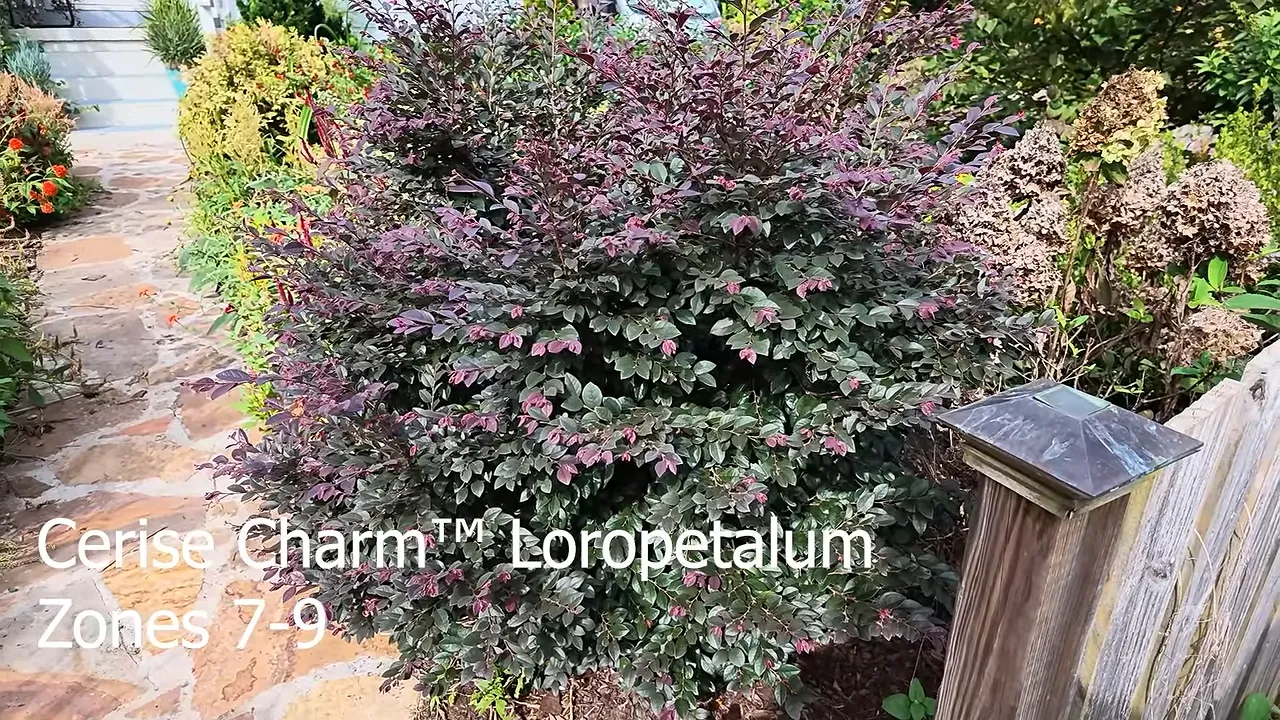
Purple Daydream is another excellent compact selection. After about four years, ours was roughly 3½ feet tall and 4 feet wide with essentially no work. A little light pruning after spring flowering may eventually be useful, but it has not needed constant size control.
Its fringed flowers are nearly red, rather than the more typical pink associated with purple-leaved loropetalums. It also holds purple foliage well into the interior of the shrub, an improvement over older selections that could be purple outside and green in the middle.
Give dark foliage something bright nearby. Purple plants can disappear against a dark background. We paired Purple Daydream with variegated Miss Lemon abelia and yellow Everillo carex. Yellow foliage, white flowers, brighter flowering plants, and lighter greens all help that purple stand out.
Emerald Snow
Not every loropetalum needs purple leaves. Emerald Snow has deep green foliage and white, witch hazel-like flowers. It flowers heavily in early spring, followed by some residual summer bloom. Timing varies with location: flowering can begin in February in Florida, while mid- to late March is more typical around Raleigh.
After flowering, lighter new growth contrasts with the older dark leaves for a couple of months. Ours is about 3½ feet tall and 4 feet wide. The branches rise and then arch downward, creating a natural shape without the awkward vertical shoots that make some loropetalums look as though they always need pruning.
Compact Nandinas for Red, Burgundy, or Chartreuse Color
The specific nandina selection matters. The compact selections discussed here are not the same proposition as planting ordinary, fruiting nandina. Obsession and Lemon Lime do not flower or produce berries, and the compact Firepower and Blush Pink selections are tame landscape choices in my experience.
Obsession
Obsession combines green foliage with burgundy-red growth. It carries strong color through winter and produces that two-tone effect whenever it is actively growing. It is an easy way to get more out of a foundation shrub than a uniform green mound.
Lemon Lime
Lemon Lime has chartreuse new foliage that becomes especially bright with sunlight. Nursery plants grown under shade cloth can look greener than the finished plants will look once exposed to more sun.
This is one I would give some time. During the first year or two, it is a nice shrub. Once it has two or three years in the ground and a substantial root system, it becomes a much better ornamental plant. Around 3 feet tall and wide, it develops the mass and strong chartreuse presence that make it so useful.
Firepower and Blush Pink
Firepower is largely green in summer, sometimes with reddish new growth, then turns a striking fire-engine red in winter. Cold and direct sunlight help develop that winter color, so sheltered greenhouse plants may not show its full potential.
Blush Pink offers a similar winter effect with an extra season of interest: blush-pink new growth during spring and summer. If the two look similar at the garden center in winter, that warm-season growth is an important difference.
Think of these as roughly 3-foot plants, occasionally reaching closer to 4 feet. They may spread modestly over the years, but they do not take over large spaces in the way people sometimes expect from nandina. Firepower is also one of the plants I would consider for a tough, sunny foundation, including a hot west-facing brick wall.
Abelias for Variegation, Summer Flowers, and Pollinators
Radiance
Our Radiance abelias are about 2½ feet tall, with bright variegated foliage and flowers through much of summer. Bees are all over them when they are blooming. They are also incredibly drought tolerant once established in our garden.
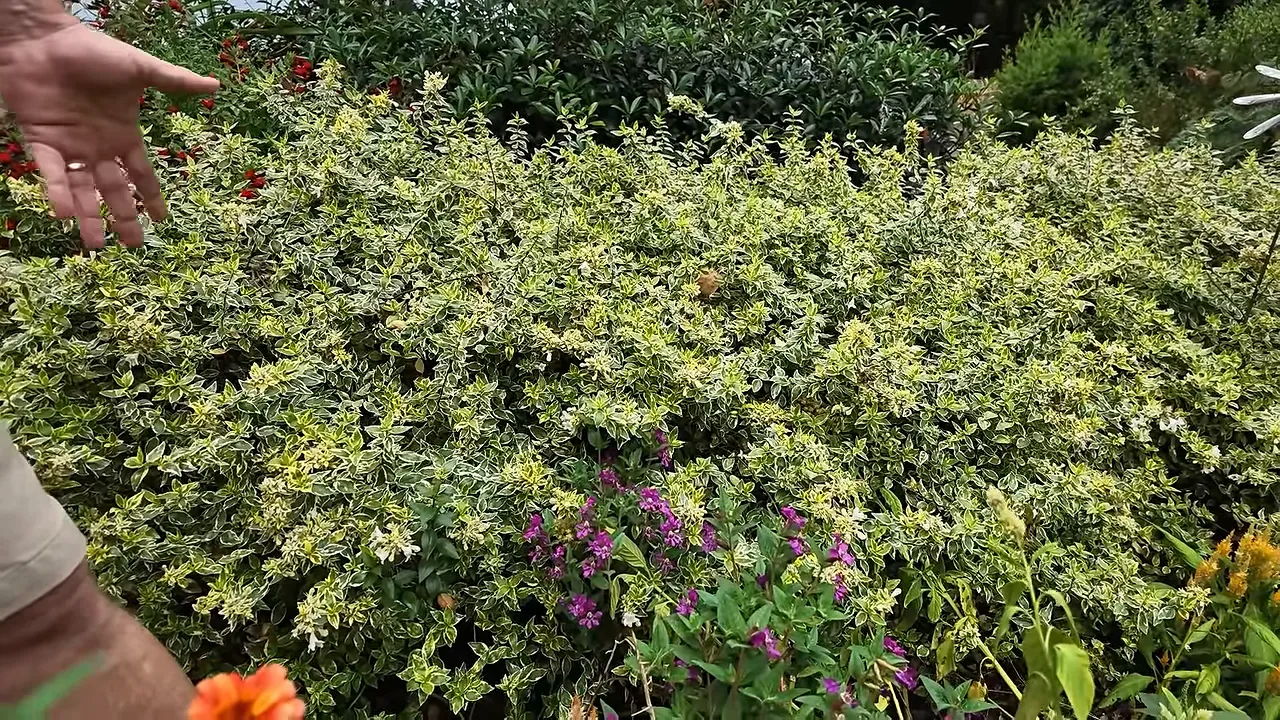
That is a useful combination beneath windows: a low shrub, foliage contrast, a long flowering season, and pollinator activity instead of just another solid green shape.
Rose Creek
Rose Creek is a compact green-leaved abelia that generally reaches about 3 to 4 feet tall and wide. It fills itself into a rounded shrub with very little intervention. If a branch leans one way, the plant tends to fill in elsewhere rather than requiring you to correct every little irregularity.
White flowers continue through much of summer. The rose-colored calyces, the structures where the flowers attach, remain after the petals fall. Those persistent clusters make the shrub look as though it has shifted from white flowers to reddish ones.
Rose Creek is tough in full sun or part shade and usually needs little pruning. If necessary, it can be cut back in late winter or early spring. Canyon Creek is another option with gold-toned foliage, although I tend to be more drawn to some of the other compact variegated abelias.
Clean Sweep Snowbank Indian Hawthorn for Low Windows
Clean Sweep Snowbank is one of those little evergreen shrubs that earns its space by not asking much from you. It forms a low dome, making it particularly useful where traditional foundation shrubs would quickly block a window.
Expect roughly 2 to 3 feet in height and 3 to 4 feet in width over time. In an earlier observation, ours was only about 18 inches tall and 2½ to 3 feet wide after three years. After four or five years in place, it was still a neat, unpruned mound.
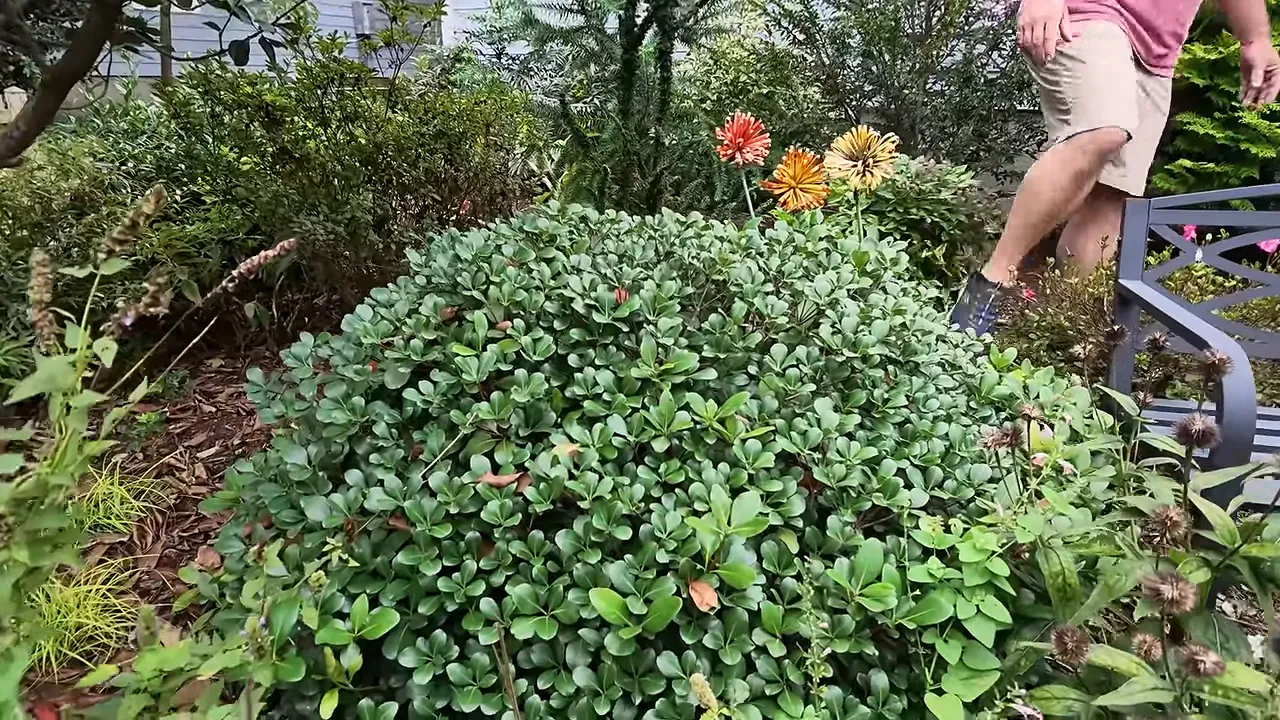
Older Indian hawthorns developed a reputation for leaf spot and defoliation. The Clean Sweep selections were developed for improved leaf spot resistance, and Snowbank has stayed very clean in our garden.
Spring brings a heavy display of lightly fragrant white flowers. Reddish new foliage follows, then settles into green. Later, dark purple to almost black fruit adds another small ornamental detail.
This is a full-sun option. If you need something taller, Spring Sonata, another selection in the series, grows more in the 4- to 5-foot range.
Gardenias and Azaleas for More Flower Power
Frostproof Gardenia
Frostproof gardenia makes a glossy, dark green mound about 3 to 4 feet tall and wide. The narrow, shiny leaves and compact shape would make it useful even without flowers.
But it does flower, and that is a pretty good bonus. Small to medium-size double white blooms carry the familiar gardenia fragrance. The main display is typically May and June here, later than many spring-flowering shrubs. That later timing helps it avoid some of the surprise cold that damages earlier flowers.
Scattered flowers can continue into summer and fall. Frostproof is also remarkably uniform in groups, which is useful when you want several shrubs along a foundation to look alike. I grew and sold tens of thousands of these over the years, and that consistent, compact habit was a big part of their appeal.
Autumn Lilac Encore Azalea
Autumn Lilac may be my favorite Encore azalea. It has unusually large, single, pale purple flowers on a small, full plant. There is no mistaking the flower color for anything other than purple.
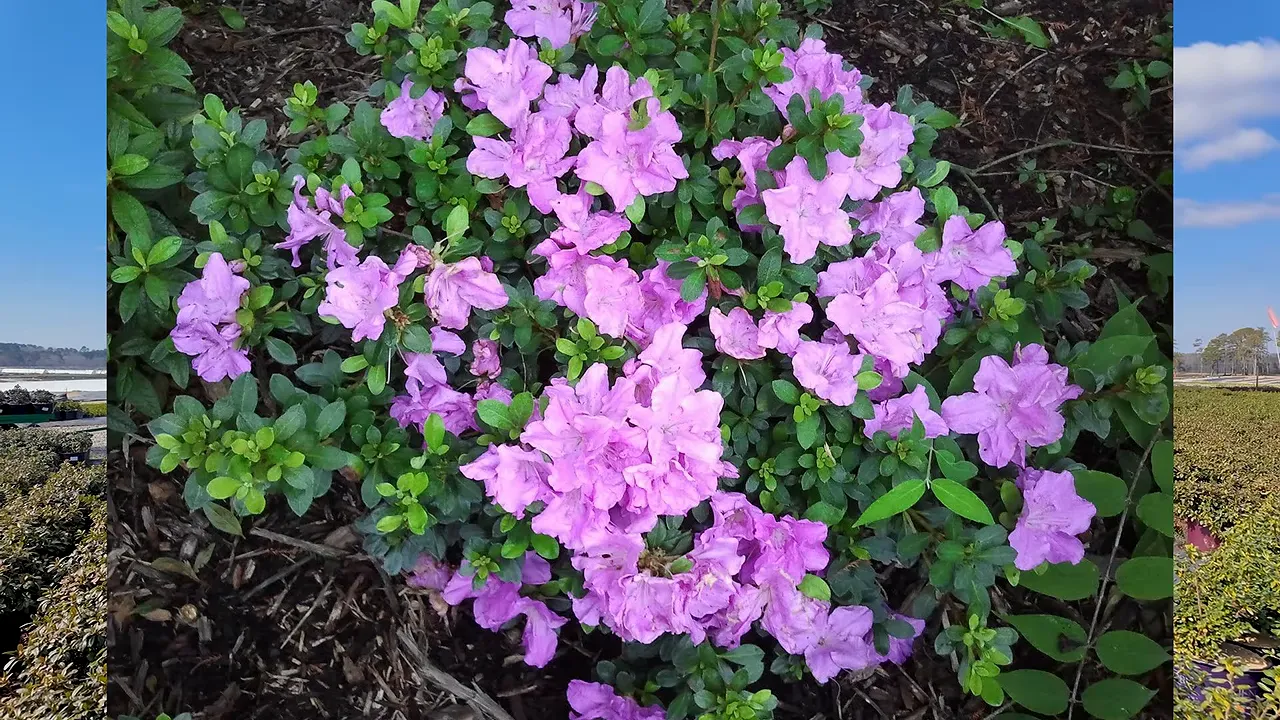
Ours was a little under 3 feet tall and narrower than 3 feet after about 3½ years, with almost no pruning. It does not stretch much, stays full between flowering periods, and can cover itself in flowers in both spring and fall.
Autumn Lilac is also one of the zone 6-hardy Encore selections, giving it a little more cold tolerance than some others in the group.
Other Hollies That May Fit Better Than Compacta
Replacing Compacta does not mean you have to give up hollies altogether. Different species and cultivars bring very different strengths.
Hoogendorn Japanese Holly
Hoogendorn is one of my favorite low-growing Japanese hollies, and I think it is underused. Helleri and Soft Touch are more familiar names, but Hoogendorn has held up better for me overall in the landscape.
It has the small, rounded, non-prickly leaves people like about Japanese hollies, with a compact habit and rich dark green color. Unpruned, think roughly 3 to 4 feet tall and wide. It can also be maintained as a low dome around 2 feet tall and 3 feet wide.
A pruning in late winter or early spring, a few inches below the size you want it to reach that season, is often all it needs. It works in full sun or part shade.
Carissa Holly
Carissa is a broader-leaved, low-doming holly with lustrous green foliage. It does have a sharp point at the end of each leaf. This is not a shrub to hug, and gloves are a good idea when pruning it.
I kept Carissa hollies on my old foundation for more than twenty years at about 2 feet tall and 3 feet wide. Left alone, they can reach about 4 feet tall and 6 feet wide.
Once a year, when they need size control, I cut them about 6 inches below the size I want for that growing season. They fill back out on their own. Occasionally, a plant produces a reverted shoot with much spikier leaves. Cut those shoots out when you find them.
Carissa is grown primarily for foliage and durability, not a red berry display. It handles sunny, hot, dry, difficult foundation conditions remarkably well.
Shamrock Inkberry Holly
For a native alternative, Shamrock inkberry is worth considering. Inkberry, Ilex glabra, is native to the southeastern United States, and Shamrock was selected for a fuller ornamental habit.
The important caution is that inkberries tend to lose foliage at the bottom with age. Some pruning at the top may encourage a little filling in, but I would not expect it to stay leafy to the ground forever.
Tags commonly suggest 3 to 4 feet. I would plan for about 4 to 5 feet, knowing that older plants can reach 5 or 6 feet. Use smaller plants in front if a bare lower portion would bother you.
Inkberry tolerates moist conditions and can become fairly drought tolerant once established. That makes it useful on a side of the house that stays damp in winter but becomes sunny and dry in summer. It can develop purplish winter foliage, especially in colder locations, and produces black fruit. The NC State Extension inkberry profile is a useful reference for checking its site requirements.
Dwarf Yaupon Holly
Dwarf yaupon is another excellent southeastern native option. It can be used formally, including clipped hedges or knot-garden shapes, but it is equally useful as a simple rounded foundation shrub.
It tolerates cooking-hot full sun and does well in part shade, though not deep shade. Gray stems are a helpful identifying feature. New growth often has a burgundy cast, and the selection Bordeaux is especially notable for its wine-red flush.
Most tags put dwarf yaupons around 3 to 4 feet tall and wide. They are easy to maintain there, but they can grow larger over decades. We have seen neighborhood plants around 7 feet tall after being left alone for roughly thirty years. That is not a reason to avoid them, just a reminder that “dwarf” does not mean permanently motionless.
Boxwoods for Formal Shape and Deer Resistance
Boxwoods are visually closer to Compacta hollies than many of the alternatives here. Their advantages include good size control and strong deer resistance. Deer resistance is a reason to consider boxwood, not a guarantee that every plant is immune to browsing.
Better Boxwood Selections
The Better Boxwood line includes blight-resistant selections in different sizes. That lets you choose a plant for the available space rather than buying one size and trying to force it into every location.
For a low window, choose a selection suited to that height. Skylight, the one in our garden, reaches about 6 feet and makes more sense at a corner or another taller planting position.
Wintergreen and Green Velvet
Wintergreen is a familiar landscape boxwood because it holds green winter color better than many older boxwoods. Around the South, it stays green through most winters, though colder conditions can bring some color change.
Think roughly 2 to 4 feet tall, usually a little wider than tall. A plant maintained at 2 feet might be about 2½ feet wide; one allowed closer to 3½ feet might spread 3½ to 4 feet.
Green Velvet is a hybrid boxwood with a full, compact habit, commonly listed around 3 to 4 feet tall and wide. It can eventually exceed that, but it takes well to shaping into balls or more upright forms. It also holds winter green color well.
I like using a few formal plants even in our very informal garden. A clean, rounded boxwood gives the eye somewhere to rest among all the seasonal changes.
Golden Dream and Variegated Common Boxwood
Golden Dream is a littleleaf boxwood with bright yellow to chartreuse leaf margins. It is commonly listed around 2 to 3 feet tall and wide, although it can grow larger. Many people will maintain it as a low, roughly 2-foot mound.
It can also be shaped into a cone, pyramid, or topiary. Light shade is fine, but deep shade reduces the foliage color.
Variegated common boxwood, Buxus sempervirens ‘Variegata’, is slower growing and wonderfully showy without losing that formal boxwood character. We have one shaped as a ball and another being developed into a multi-ball topiary. It also works in containers.
This common boxwood is blight susceptible. I prefer using my own clean pruning tools rather than risking contaminated equipment coming into the garden. For more background, see Virginia Cooperative Extension’s boxwood blight resources.
Colorful Broadleaf Evergreens for Sun or Shade
Sunshine Ligustrum for Sunny Spaces
Sunshine ligustrum keeps bright gold foliage through the year and does not flower or produce fruit. That distinguishes it from the ordinary fruiting Chinese privets people understandably worry about.
It responds readily to pruning. You can maintain a small rounded shrub, shape a taller pyramid, or let it become a larger specimen. Left to grow, it can reach 6 feet or more, so a little 2-foot ball represents maintenance, not its permanent natural size.
In the home landscape, give it sun for that rich gold color. Do not let nursery shade cloth confuse you. Growers may use partial shade during production and then move plants into more sun before sale.
It works as a corner foundation shrub, a low screen, a container plant, or a bright specimen.
Florida Sunshine Illicium for Shade
Florida Sunshine illicium is not the choice for a low window. Ours is about 6 feet tall, and it is better considered for a taller shady foundation space or a hedge where 6 to 10 feet would be useful.
Its chartreuse to yellow foliage and pink stems brighten part shade or shade beautifully. Ours lights up a darker area beside the shed. Against a dark green rhododendron or another shade evergreen, the contrast is especially effective.
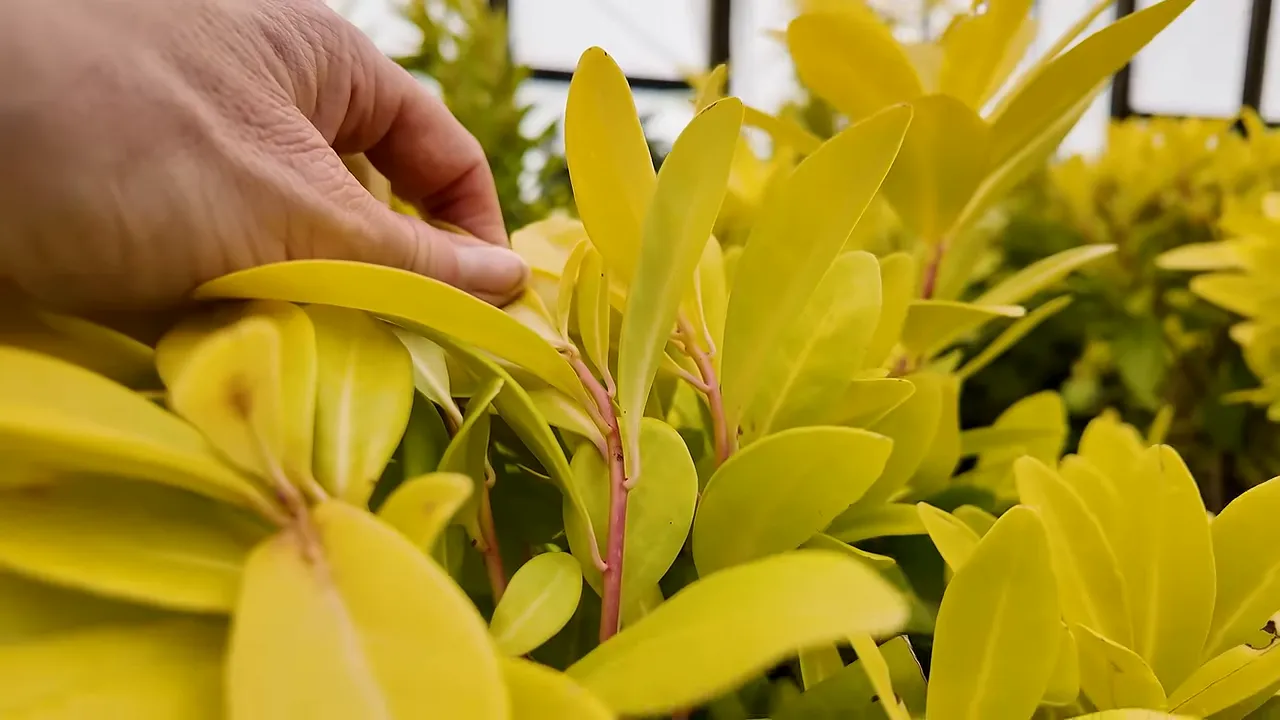
Mojo Pittosporum for a Low Shady Mound
Mojo pittosporum is one of our favorite low-doming evergreen shrubs. We have four, and in a garden where we tend to have one of everything, that tells you something.
It works well in part shade or shade. Older foliage has creamy, off-white variegation, while actively growing foliage is more gold on green. Small flowers are tucked inside the shrub and are more noticeable by fragrance than appearance, usually after the plant has had time to establish.
Our plants remained under about 2 feet tall after four years without pruning. A group makes a useful low evergreen mass that covers the ground and asks very little of us.
Cast in Bronze and Bayou Bliss Distylium
Distyliums are useful leafy evergreens when you want a quiet, low-maintenance foundation planting.
Cast in Bronze has a spreading, somewhat arching habit, small red flowers close to the stems, and bronze new foliage whenever it is actively growing. It can be maintained below about 4 feet tall with roughly 4 to 5 feet of spread, making it useful along a sunny foundation.
Bayou Bliss is the more compact option where you want something around or below 2 feet. Choose between them based on available space, rather than assuming all distyliums have the same habit.
Osmanthus for Variegation, Fragrance, and Flexible Shaping
Goshiki Osmanthus
Goshiki means “five colors” in Japanese, and the foliage earns the name. Pinkish-red new leaves settle into bright variegation, with older growth becoming darker green.
The leaves look more threatening than they really are. It also produces fragrant flowers, although young plants can take years to begin flowering well.
Tags often suggest something in the 3- to 6-foot range, but I have seen an established plant around 8 feet tall at the JC Raulston Arboretum. It can be sheared in late winter or early spring into pyramids or narrower upright forms. Use it where you either have room for the eventual size or are happy to do that shaping.
Kaori Hime Osmanthus
Kaori Hime has tiny leaves, only about half an inch long, giving it an unusually fine, compact-looking texture. Tiny foliage does not mean it will remain a 2-foot shrub, though. It grows more slowly than some other osmanthus, but ultimately gets considerably larger.
It takes tight shearing well and can also be allowed a looser form. Fragrant cool-season flowers appear as days shorten and soil temperatures drop, although flowering may take a few years to begin. In the colder part of its growing range, give it a protected position.
Conifers for Soft Texture and Year-Round Structure
Conifers change the texture of a foundation bed immediately. Mix them with broadleaf evergreens rather than expecting another small-leaved shrub to provide all the contrast.
Baby Blue Ice and Night Light Chamaecyparis
Baby Blue Ice offers blue foliage in a dwarf form related to the much larger Boulevard cypress. It is an option where you want blue color and a conifer that can be kept low along a foundation.
Night Light chamaecyparis supplies soft gold texture. It is closer to Compacta holly in overall scale, so think of foundations with windows around 5 to 6 feet above the bed rather than very low windows. It is also useful mixed among green shrubs to interrupt a repetitive row.
Globosa Nana Cryptomeria
Globosa Nana is a round-growing dwarf Japanese cedar and a tough conifer for the Southeast. It fills itself into a neat, rounded plant without needing constant corrective pruning.
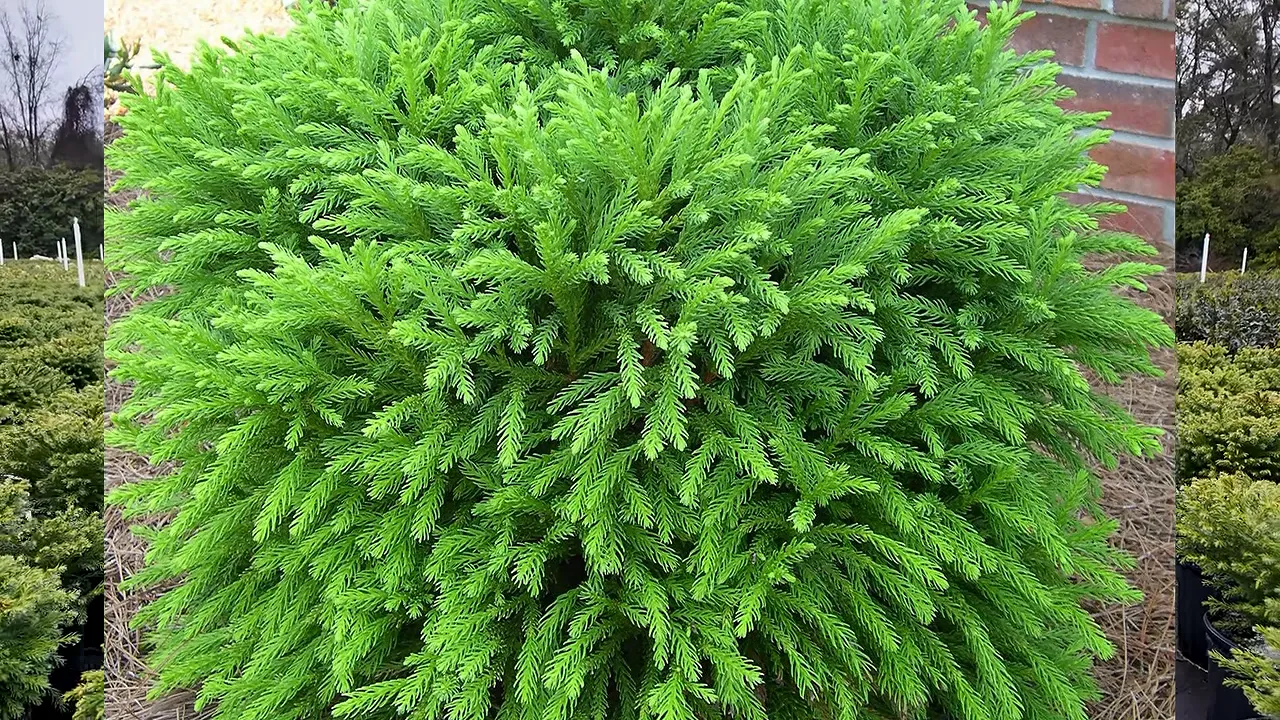
It is easy to maintain around 3 to 4 feet tall and wide, but it can eventually reach about 6 feet. Allow for roughly equal height and width. It may bronze a little in colder winters, though it tends to hold green better than many other conifers.
This is a useful evergreen backdrop for perennials and other plants that disappear or lose their leaves in winter.
Fire Chief Arborvitae
Fire Chief is a soft, rounded arborvitae with changing foliage color. During active growth it can carry pinkish to burgundy tones over warmer-colored foliage, with green deeper inside where sunlight does not reach.
I have seen plants around 4 to 5 feet tall and wide, as well as plants maintained much smaller. Late winter or early spring is the time for size control before the new flush begins.
Winter color becomes rustier in colder areas and can be stronger in containers. That seasonal change is part of its appeal rather than a failure to stay the same.
Woodward Globe Arborvitae
Woodward is an older globe arborvitae with soft foliage that is pleasant beside a sidewalk. I had one on my foundation for about twenty years.
The problem was not the plant. I wanted it to stay 3 to 4 feet tall, and it wanted to be 5 to 6 feet. After years of size control, it looked tired enough that I removed it. With room to reach 6 feet, I could simply have let it grow.
Older plants can thin at the bottom. That can be an opportunity for underplanting rather than a reason to reject the shrub. There is nothing wrong with a good 4- to 6-foot evergreen if you have a 4- to 6-foot space.
Bowling Ball Arborvitae
Bowling Ball has very soft, fine foliage and holds a pleasing lime-green color through winter in my experience. New growth adds a lighter green flush in spring.
Although tags may suggest about 30 inches, I would allow for something closer to 3 to 4 feet tall and wide over time, with pruning if you need it smaller.
Pay attention to watering. This is not a plant that clearly announces thirst before it is in trouble. If the top couple of inches of soil are dry, check its watering needs. In zone 8, morning and midday sun with late-afternoon shade is a sensible placement.
Hetz Midget Arborvitae
Hetz Midget is a slow-growing, rounded eastern arborvitae. It eventually approaches about 3 to 4 feet tall and wide, but it takes its time getting there. I like that. A shrub that races to 4 feet may be just as interested in racing to 8.
It is cold tolerant, with a listed range around zones 3 to 8, but it is not especially heat tolerant. In southern gardens, monitor moisture closely during dry weather. Heavy deer pressure is another reason to think carefully before choosing it, because eastern arborvitae can be high on the winter browsing list.
Soft-Textured Shrubs for Shade and Dry Shade
Hedgehog Cephalotaxus
Hedgehog is one of Steph’s favorite plants, and it has a lot of character. Upright growth eventually arches outward, creating a broad, textured evergreen mound.
Expect about 3 to 4 feet of height, with increasing width as it matures. The width can be controlled where necessary. Cephalotaxus also comes in ground-covering and taller upright forms, so choose the selection that suits the space.
This is an especially good conifer for dry shade beneath established trees. It is not the plant for a wet, poorly drained shady bed. Knowing which kind of shade you have is more useful than simply writing “shade” on the shopping list.
Soft Caress and Narihira Mahonia
These mahonias challenge the idea that all mahonias are stiff and prickly. Both have soft-textured foliage that contrasts beautifully with the broad leaves common among southern shade shrubs.
Soft Caress is the more compact option, useful around the 2- to 3-foot range. It works in containers or in the ground in part shade or shade.
Narihira is the larger alternative, generally around 3 to 4 feet tall and similarly wide. Its foliage has a mix of blue-green, dark green, and burgundy tones, with burgundy-tinted new growth in spring.
Yellow winter flowers add another season of interest. When flowering coincides with a warm enough day for bees to be active, the bees find them quickly.
Viburnums for Flowers, Fruit, and Changing New Growth
Viburnum tinus, including selections such as Spring Bouquet, is one of those plants I always stop to appreciate. It has dark evergreen foliage, white flower clusters, metallic-looking dark fruit later in the year, and lighter new leaves with burgundy coloring.
It seems to be doing something interesting whenever it is actively growing. But it is not the easiest shrub on this list.
It can start flowering and growing too early, leaving young growth vulnerable to cold. Young plants in Raleigh can suffer winter damage before they develop the size and maturity that make them tougher landscape plants.
Tags may suggest about 4 to 5 feet, but very old plants can be much larger. We have seen one around 8 or 9 feet tall on NC State’s campus. This is another choice for a roomier position, not automatically a low-window replacement.
Moonlit Lace, a hybrid between Viburnum tinus and Viburnum davidii, is also worth looking for. Both parents can be a little finicky, yet the hybrid has impressed me as a tough ornamental plant.
Build a Foundation Planting That Does More
You do not have to rip out every Compacta holly to improve a landscape. Even if you keep some, mix in different foliage sizes, colors, and textures. Broad glossy leaves, soft gold conifers, purple foliage, and low variegated mounds can work together without turning the foundation into a collection of unrelated plants.
The most useful combinations start with the conditions:
- For low windows: Consider Snowbank Indian hawthorn, Mojo pittosporum, Bayou Bliss distylium, or a suitably compact boxwood selection.
- For hot, sunny foundations: Look at Carissa holly, dwarf yaupon, Firepower nandina, abelias, and sun-suited distyliums.
- For shady color: Consider Mojo pittosporum, soft-textured mahonias, or Florida Sunshine illicium where there is room for height.
- For dry shade: Hedgehog cephalotaxus is a particularly useful option.
- For a more formal look: Boxwoods, Hoogendorn holly, and clipped dwarf yaupons offer alternatives to a standard row of Compactas.
A mixed planting also spreads risk. A pest, disease, drought, or other problem may affect one kind of plant more severely than another. Depending entirely on one shrub means depending entirely on its ability to handle whatever comes next.
I like compact evergreen shrubs because they provide a dependable framework while annuals, perennials, and flowering plants come and go. Choose that framework for the space you actually have, and you can spend a lot less time fighting shrubs and a lot more time enjoying the garden.


