On a street where most of the landscape is Bermuda grass, a garden packed with maples, dwarf conifers, flowering salvias, and even Oklahoma native palms gets your attention pretty quickly.
This is Kadin Bieberich’s home garden in Clinton, Oklahoma, about an hour and ten minutes west of Oklahoma City. It is beautiful, but what makes it especially interesting is what those plants have been through. By the middle of October, Kadin reported roughly 60 days above 100 degrees and 130 days above 90 degrees. Add persistent wind, alkaline soil, and the possibility of bitter winter cold, and you have a fairly serious plant trial.
The lesson here is not that every unusual plant belongs in western Oklahoma. It is that good plant selection, protection from wind, and attention to the root zone can open up far more possibilities than you might expect. And when something fails, well, now there is room to try something else.
Key Takeaways
- Establish wind protection before expecting exposed ornamental plants to perform well on the Great Plains.
- Soil pH, rootstock, and plant provenance can determine success even between nearby sites.
- Layered planting, mulch, and drip irrigation help support plants through prolonged summer heat.
- Treat unusual plants as trials, and adjust the planting as performance and growing conditions change.
Table of Contents
- Start With the Site, Not the Plant Collection
- Build the Wind Protection First
- A Salvia Hedge That Feeds Hummingbirds
- Choose for Wind Tolerance, Not Just Drought Tolerance
- Use Layers to Shade the Root Zone
- Dwarf Conifers: Beautiful Plants, Honest Trials
- Maples That Are Earning Their Place
- Keep Flowers and Pollinators in the Picture
- The North Screen Adds Weeping Forms and Evergreen Structure
- What This Garden Means for Your Own Plant Choices
- A Trial Garden Is Allowed to Change
Start With the Site, Not the Plant Collection
Before getting excited about the plants, it helps to understand what is underneath and around them.
Kadin’s garden sits on a substantial hill. The soil pH is about 7.5, compared with approximately 8.3 at Sunshine Nursery. Both are alkaline, but that is a meaningful difference. The pH scale is logarithmic, so those numbers are not nearly as close as they might look.
That difference affects which plants, and even which rootstocks, will perform well. A tree that manages at the house may struggle at the nursery.
Two other things are doing a lot of work throughout these beds:
- Shredded cedar mulch: It knits together, covers the soil, and helps keep weed pressure down.
- Drip irrigation: The beds are equipped with drip so water can be delivered where it is needed without using as much of it.
This is not a collection of plants simply dropped into an exposed yard and left alone. The planting has support. If you are working with unfamiliar soil, the Oklahoma State University Extension is a useful starting point for local soil-testing and plant-selection guidance.
Build the Wind Protection First
The day before my visit, the wind was blowing around 35 miles per hour. Driving west into it was plenty of explanation for why the garden needs shelter.
It is tempting to begin a landscape by buying a few foundation shrubs and arranging them against the house. Out here, those shrubs are still sitting in the wind. Kadin has instead built living screens on the north and south sides, using a mix of narrow deciduous trees and evergreens.
The screens provide privacy, reduce exposure, and create some shade for nearby root zones. Once you step inside the planting, it feels much less like the middle of a neighborhood.
A Mixed Screen With Plenty of Personality
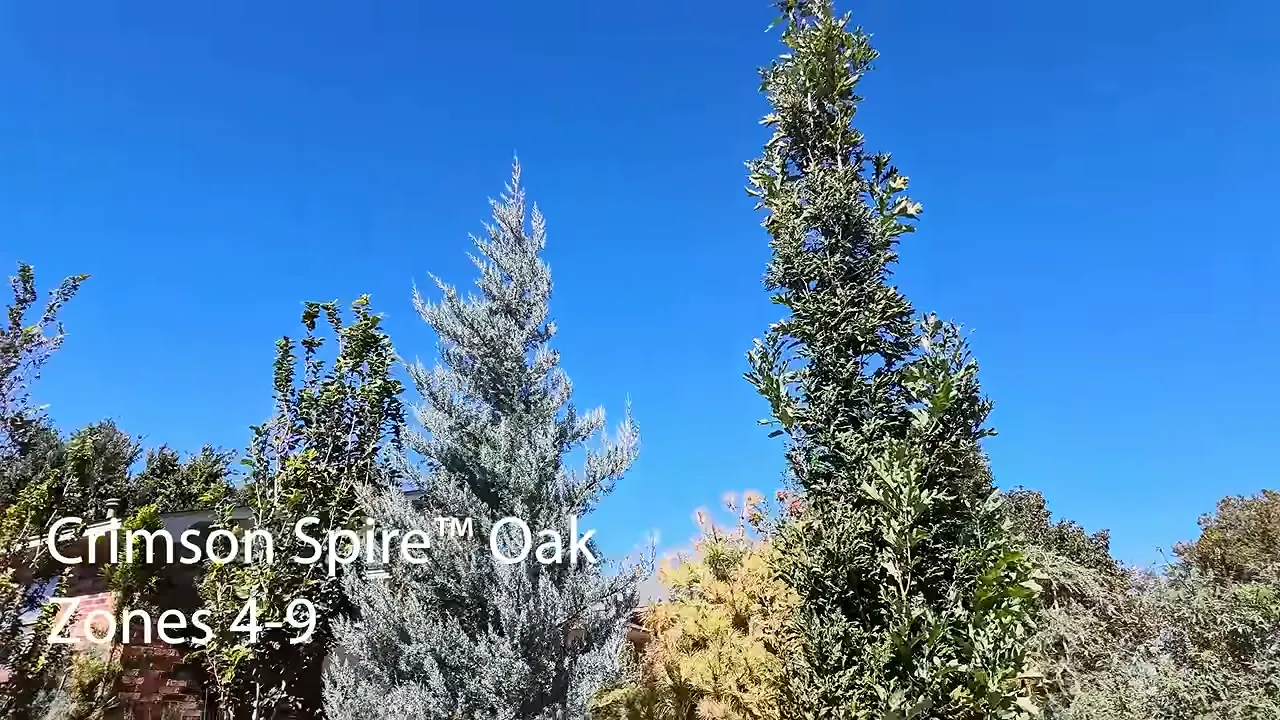
The southern planting is not one repeated tree. It is a trial of different upright forms, including:
- Crimson Spire oak: A very narrow oak that contributes a strong vertical line.
- Arizona cypress: Blue foliage and evergreen coverage keep part of the screen working after the deciduous trees lose their leaves.
- Persian ironwoods: ‘Persian Spire’ and ‘Inge’s Ruby Vase’ bring dense foliage and upright structure, with ‘Ruby Vase’ offering a compact habit.
- An upright Asian elm: Another opportunity to evaluate narrow growth and useful branch structure.
- ‘Chimney Fire’ oak: A particularly good example of why the rootstock matters.
- ‘Slender Silhouette’ sweetgum: A familiar choice when you want a decidedly vertical tree.
- Columnar Carolina buckthorn: Attractive foliage, although this specimen has widened enough that Kadin plans to trim it back.
There is also an empty space where an Alaskan cedar did not work out. That is part of the story, too. A trial garden should tell you what failed as well as what succeeded.
Rootstock and Provenance Matter
The ‘Chimney Fire’ oak is grafted onto Quercus bicolor, swamp white oak. That rootstock is more comfortable with the relatively lower pH at the house than it would be with the more alkaline conditions at the nursery. A combination that is not ideal for one site can sometimes manage at another.
The same principle shows up in the sugar maples. ‘Newton’s Sentry’ has the narrow habit Kadin wants, but its thinner foliage takes a beating in the wind. He is considering replacing it with something that maintains better leaf quality.
Compare that with the Caddo sugar maples associated with the region’s isolated populations. Those trees developed under much tougher local conditions, including dry, sandy sites, and their foliage handles the wind better. The name on the label matters, but where the plant’s genetics came from can matter just as much.
A Salvia Hedge That Feeds Hummingbirds
Along the border is a long planting of ‘Blush Pink’ Salvia greggii, roughly 23 or 24 plants. It gives the garden a repeated element beneath all those different trees, and the hummingbirds travel up and down it in the afternoons.
It is also refreshingly straightforward to maintain. Kadin cuts the plants back once a year to about a foot above the ground, which helps keep the hedge dense. As the days shorten, the flowering becomes especially impressive.
The less enjoyable maintenance job is pulling Siberian elm seedlings out of it.
Siberian elm is a dominant invasive tree in this area, and its tendency to volunteer everywhere and develop structural problems has given elms in general an undeserved reputation. There are other elms better suited to landscape use here. One troublesome species does not make the entire group a bad choice.
Choose for Wind Tolerance, Not Just Drought Tolerance
A plant can tolerate dry soil and still look terrible after a summer of wind. That is an important distinction in Great Plains gardening.
A pink-flowered vitex from an older garden in Clinton has performed very well here. It supports pollinators through summer, holds up in the wind, and has aromatic foliage that is generally unappealing to deer.
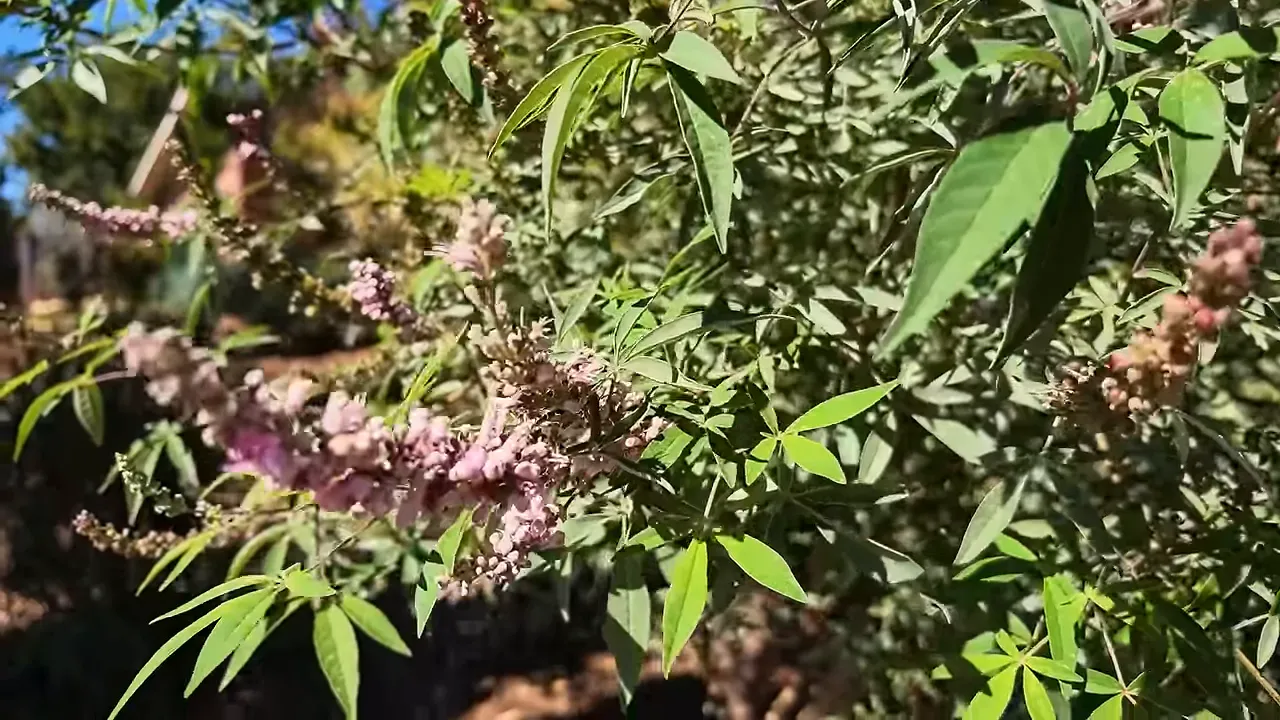
A nearby Tibetan lilac, Leptodermis oblonga, adds another interesting flowering shrub. Kadin finds that it blooms in both spring and fall at this site, and it matures at around 3 to 4 feet tall. Despite the common name, it is not a true lilac.
We kept coming back to fragrant foliage as we moved through the garden. In a harsh climate, losing leaves to browsing is especially costly because a plant may not have the moisture available to replace them quickly. Aromatic plants such as vitex, santolina, salvias, and Russian sage offer useful options, although fragrance should not be treated as a guarantee against every animal.
Nothing Has to Stay in the Wrong Place
The vitex has started swallowing up a ‘Young Lady’ smoketree, so the smoketree will probably move. Elsewhere, a Salvia greggii is getting too much shade as the surrounding trees grow. That plant will make way for something more shade tolerant.
That is normal gardening. The conditions change as plants mature, and the planting can change with them. There is no prize for keeping a plant in a spot where it no longer works.
Use Layers to Shade the Root Zone
One of the most useful ideas in this garden is also one of the easiest to miss: Kadin is deliberately using plants to shade the soil around other plants.
The windbreak helps, but so do lower-growing companions. Around a Korean maple, Oklahoma-source dwarf palmettos and santolina help cover the root zone. Against a hot brick wall, a weeping Arizona cypress is being encouraged to spread across the slope as a blue groundcover.
That brick absorbs heat and releases it back into the planting. A little shade at soil level goes a long way in a spot like that.
Yes, There Are Oklahoma Native Palms
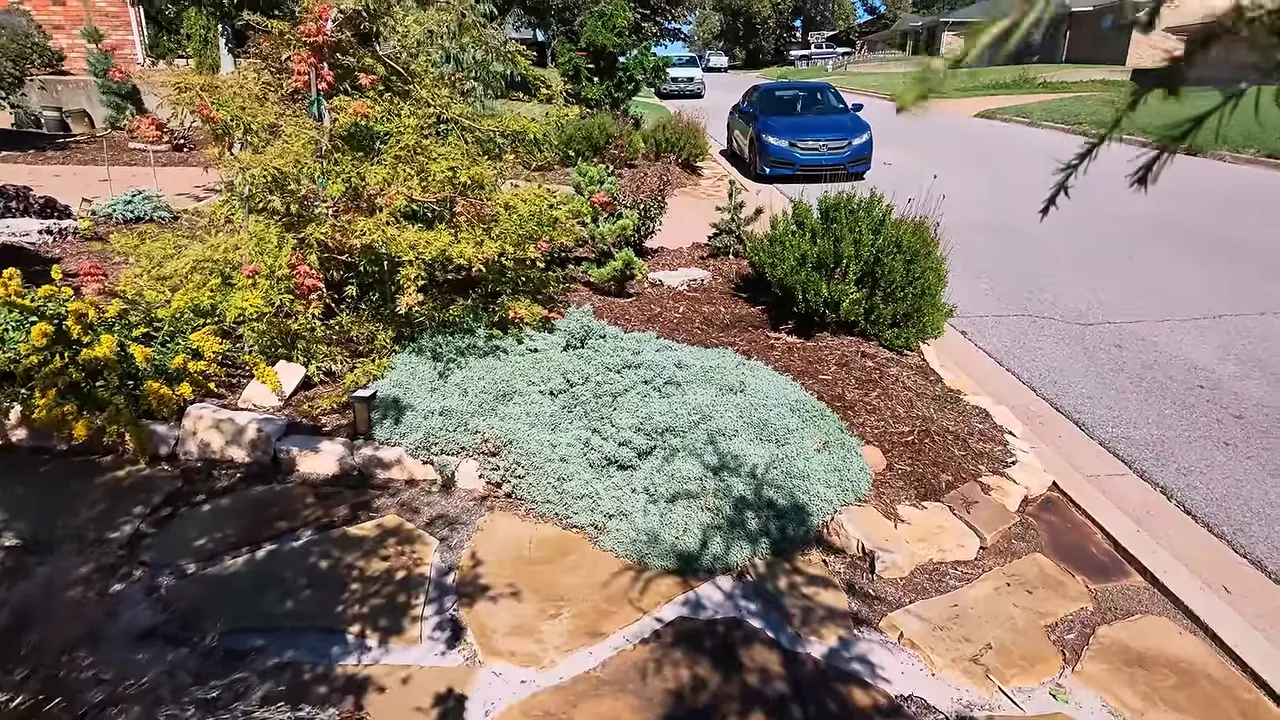
The palms are Sabal minor, dwarf palmetto, from Oklahoma material associated with the Tom area in the southeastern part of the state. They remain relatively small, around 3 to 4 feet tall in the form discussed here.
Kadin reports exceptional cold tolerance from this material, including plants grown in Wichita. That is a provenance story, not permission to assume any palm will handle western Oklahoma. The source of the plant is the important part.
The santolina alongside it is equally valuable in a completely different way. Its silvery blue foliage looks terrific against the stone, and its fragrance is remarkable.
Dwarf Conifers: Beautiful Plants, Honest Trials
Kadin has an affinity for dwarf conifers, and the garden gives him plenty of opportunities to find out which ones can cope.
Near the corner is ‘Agnieszka’ ponderosa pine, a Polish selection with yellow banding on its long needles. The variegation is subtler than on ‘Golden Ghost’ Japanese red pine, whose yellow coloring is much more obvious.
‘Golden Ghost’ burned during its first few years. Once it developed a larger root system, its performance improved considerably. By this visit it looked beautiful and had produced a second flush of growth. As it fills out, it is also beginning to shade itself.
That is a useful establishment lesson, but it does not mean every scorched plant will eventually become happy. Some improve with roots and shelter. Others are telling you they need a different location.
Small Pines With Different Responses
The collection includes ‘Marshall Gulch’ Southwestern white pine, a dwarf pinyon identified by Kadin as ‘Fatty Blue,’ and ‘Dusty Blue’ ponderosa pine. There is also ‘Uncle Fogy’ jack pine, Pinus banksiana, which had made it through the summer despite its northern origins.
That last one is exactly why trialing is worthwhile. On paper, it is not the first tree you would expect to enjoy this climate. Surviving one summer is encouraging, though it is not the same thing as proving long-term performance.
Other experiments show the limits more clearly:
- ‘Kinpo’ Japanese white pine: Showing some burn in an exposure Kadin considers near the edge of what it can handle.
- ‘Chief Joseph’ lodgepole pine: Barely through the summer, with another season needed to judge whether it deserves the space.
- ‘Barabits Requiem’ giant sequoia: An unusual weeping specimen with some damage, but still part of the experiment.
- ‘Foxtail’ Southwestern white pine: A narrow form intended to grow up and help complete the screen.
Blue Spruce Needs Water Here
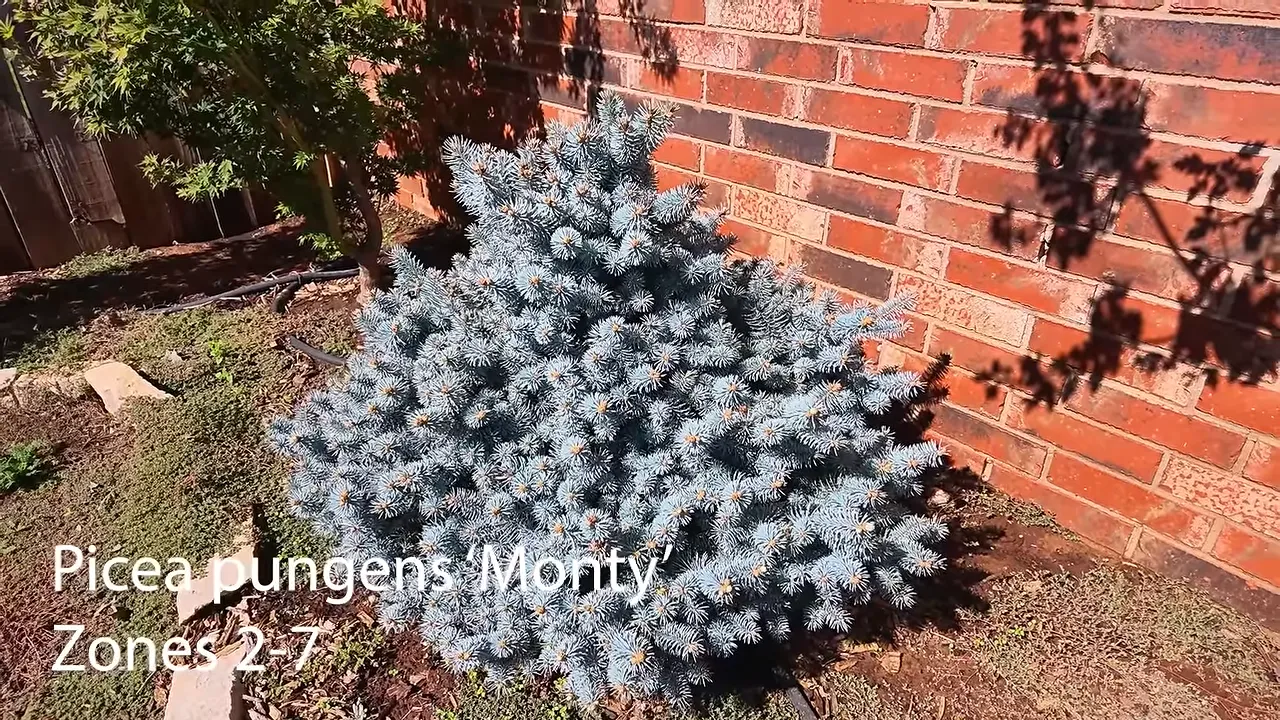
Two Colorado blue spruce selections, ‘Moonstone’ and ‘Monty,’ have striking icy blue foliage. ‘Moonstone’ is particularly dense, while ‘Monty’ makes a compact, intensely colored specimen beside the brick.
The important detail is the drip irrigation. Kadin’s experience is that blue spruce in this heat cannot be allowed to dry out. These plants are not evidence that every blue conifer is drought tolerant. Their success has to be understood alongside the care they receive.
Maples That Are Earning Their Place
There are far more maples here than most people would expect in a hot, exposed Oklahoma garden. Some have tired foliage by October. Considering the summer they endured, having leaves at all is an accomplishment.
Korean Maple Hybrids
‘Ice Dragon’ has held up well in sun, retaining its dissected, lacy foliage and producing a late flush. ‘First Flame’ also pushed new growth late in the season and is especially valued for its fiery spring color.
‘Alpenglow’ still looked good after the brutal summer, and ‘Avalanche’ is another selection growing near the house. These plants broaden the possibilities for gardeners who want that maple character but need to experiment beyond the usual choices.
Japanese Maples in Protected Pockets
The Japanese maple collection includes ‘Kurenai jishi,’ a red spring-flushing selection grown here on a high graft, along with ‘Mikawa yatsubusa’ and ‘Shishigashira.’ Low-growing companions, including ‘Cave Hill’ and a dwarf common juniper, help fill the space around them and shade the soil.
They are not all pristine. That is worth saying. This is a mid-October assessment after prolonged extreme heat, not a collection photographed only during its best week in spring.
One plant, ‘Purple Haze,’ is simply too scorched to justify keeping in that position and is scheduled for replacement. Kadin’s wife, Madison, is apparently very good at pointing out when an experiment has reached the burnt-toast stage.
Shantung Maples Deserve Attention
The foliage on ‘Baby Dragon’ Shantung maple, Acer truncatum, was especially impressive. Its tiny leaves are about thumbnail size, and they looked remarkably good compared with the damage on some of the other maples.
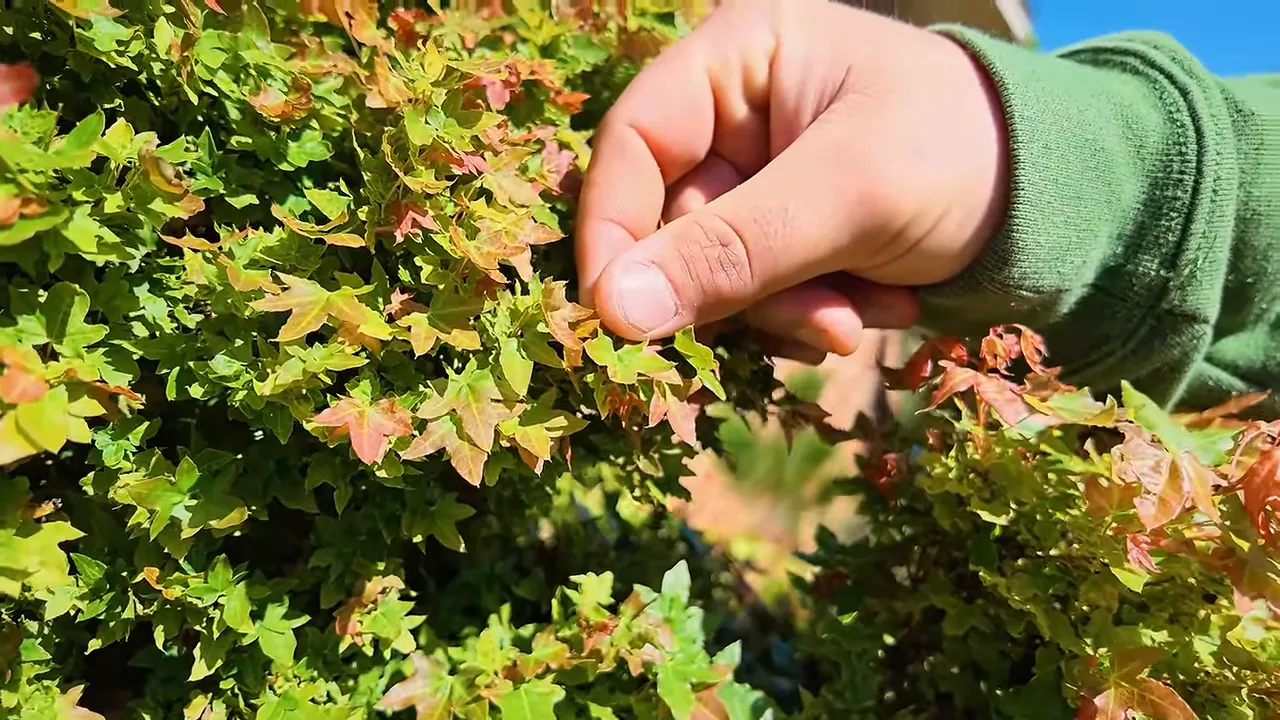
Kadin is enthusiastic about Shantung maple cultivars because of their combination of heat, drought, and cold tolerance. He describes them as hardy into Zone 4, with an important qualification: they do not want wet feet.
‘Super Dragon,’ a yellow-leaved Shantung maple, had some scorch but was putting on new growth. Even within a promising species, the cultivar and exposure still matter.
Look for Plants From Similarly Difficult Climates
Another interesting tree is Acer semenovii, grown from material connected with a Denver Botanic Gardens seed-collecting trip to Kazakhstan. Kadin looks for plants from places with a climate every bit as difficult as his own.
This maple is accustomed to rocky, poor soils and grows slowly compared with others in the Tatarian maple group. A smaller, slower-growing tree adapted to harsh conditions can be a very useful garden plant.
Keep Flowers and Pollinators in the Picture
For all the unusual woody plants, this is not just a conifer and maple collection. Flowering plants are woven throughout it.
- ‘Wichita Mountains’ goldenrod: Showy yellow flowers, foliage with a slightly blue cast, and plenty of pollinator activity. Nearly 10 inches of recent rain had made it flop more than usual.
- ‘Bee Friendly’ smooth hydrangea: A Scott Skogerboe selection emphasizing fertile, pollen-bearing flowers rather than the large showy sterile florets typical of many ornamental selections.
- ‘Desert Willlie’ desert willow: A dwarf Allan Taylor selection with fine foliage and light pink flowers marked by a deeper magenta throat.
- Blue-flowered salvia: A low, spreading plant adding a particularly vivid blue among the silver foliage and conifers.
- ‘Blue Jean Baby’ Russian sage: Fragrant foliage and prolific bloom, even with a little shade in this location.
The goldenrod is particularly good at demonstrating that weather can temporarily change a plant’s shape without making it a poor choice. Kadin normally finds it much denser than it was after that heavy rain.
There are smaller foliage surprises, too. A threadlike nandina labeled ‘Senbazuru’ is finer textured than ‘San Gabriel.’ Variegated Solomon’s seal is hanging on in a protected spot, without the aggressive spread it can show in an easier climate.
A variegated Rose of Sharon adds another texture, although Kadin notes that altheas are favorite food for grasshoppers here. Heat tolerance does not exempt a plant from insect pressure.
The North Screen Adds Weeping Forms and Evergreen Structure
On the north side, the shelter planting becomes even more sculptural.
‘Filip’s Golden Tears’ Lawson cypress is part of an experimental rootstock combination intended to give a difficult plant a better chance. That is a specialist trial, not a general recommendation to fill an exposed Oklahoma yard with Lawson cypress.
‘Tolleson’s Blue Weeping’ Rocky Mountain juniper contributes long curtains of blue-green foliage. Rocky Mountain juniper occurs not far to the west, and avoiding overly wet conditions is an important part of growing it successfully.
The weeping Arizona cypress offers a different design lesson. When staked, its leader can be trained upward into a narrow vertical element. Without that support, it wants to fall and spread.
Kadin is using that tendency both ways: keeping one plant upright for screening and allowing another to crawl across a sunny hillside to shade roots near the brick. The same growth habit can serve very different purposes depending on how it is trained.
Other vertical accents include ‘Cry Baby’ eastern redcedar and ‘Peve Minaret’ bald cypress. The latter provides a remarkably narrow form with soft, fresh-looking foliage.
What This Garden Means for Your Own Plant Choices
Many plants doing well here have useful cold hardiness, with some suited to Zone 5 and others extending into Zone 4. But cold hardiness is only one part of the decision. The USDA Plant Hardiness Zone Map helps evaluate winter minimum temperatures, not whether a plant will appreciate summer heat, wind, or wet soil.
Moving one of these plants into a wetter southeastern garden may introduce a completely different problem. A plant that handles Oklahoma heat may still need excellent drainage in Georgia.
Likewise, availability at a garden center does not prove suitability for an exposed Great Plains landscape. Kadin specifically discourages relying on red maples and American arborvitae in these local conditions. He sees red maples lose their foliage and arborvitae brown during summer. Many Chamaecyparis are questionable choices here, too.
That is why regional experience matters so much. Sunshine Nursery is a third-generation nursery experimenting with plants for high-pH soils and difficult Great Plains conditions. Its educational work, including Southern Plains Tree Lab, helps explain plants that may have very little published information available.
A Trial Garden Is Allowed to Change
This garden reminded me of the plant-filled home landscapes you immediately recognize as belonging to nursery people. The neighboring yards may have turf and a tree or two, while this one is full of experiments.
What makes it work is not a perfect success rate. It is observation. Which maple kept good foliage? Which conifer improved after establishment? Where did the growing screen create too much shade for a salvia? Which plant is simply not worth another summer in that spot?
Build the shelter, understand the soil, choose plants with the right background, and pay attention to what happens. Keep the plants that earn their place. Move the ones that need a different exposure. Replace the ones that do not work.
A beautiful Great Plains garden takes effort. This one makes a pretty convincing case that the effort can lead to something far more interesting than another yard of Bermuda grass.


