When I started in the nursery business, panicle hydrangeas were plants we thought of as tree hydrangeas. PeeGee hydrangeas and varieties such as Pinky Winky could get big. Now we have gone from tree-sized hydrangeas to hydrangeas that practically cover the ground.
That is what makes Groundbreaker hydrangeas so interesting. They have the flowers, foliage, and seasonal color we enjoy in Hydrangea paniculata, but on remarkably low, spreading plants.
Steph and I first came across them in the Netherlands, and my reaction was pretty simple: How can something that short produce all those flowers? A year later, I caught up with breeder Alex Schoemaker in Loxley, Alabama, to look closely at the three varieties arriving in the United States and talk about what went into creating them.
Key Takeaways
- Groundbreaker hydrangeas bring panicle hydrangea flowers to unusually low, spreading plants.
- Blush, Ruby, and Greeny offer distinct seasonal flower-color progressions.
- They bloom on new wood and receive an annual cutback before spring growth begins.
- The breeding program prioritizes garden performance over appearance in a nursery container.
What Makes Groundbreaker Hydrangeas Different?
The breakthrough is the ground-covering habit. These are not simply slightly smaller versions of a large shrub. They bring panicle hydrangea flowers down to a completely different level in the landscape.
Alex described the original Groundbreaker Blush as reaching about 30 centimeters tall, or roughly 12 inches. The collection emphasizes low growth and spread, with Ruby specifically described as wider than it is tall.
That changes how you can think about using a panicle hydrangea. Instead of placing it behind other plants because of its eventual height, you can picture a low flowering planting along a path or a broad bedding of flowers near the front of a garden.
And the flowers are not the whole story. The plants we examined had attractive foliage and the reddish stems familiar to many panicle hydrangeas. They are good-looking little shrubs before they flower, too.
The Three Groundbreaker Hydrangea Varieties
Groundbreaker Blush: White Flowers That Develop Soft Pink Tones
Blush is where the collection began. A breeder working with Alex noticed a plant in the field that appeared to have a ground-covering habit. Alex was not immediately convinced there would be much demand for a hydrangea like that.
That doubt did not last long. Within a year, the response made it clear that gardeners were very interested in a low-growing panicle hydrangea.
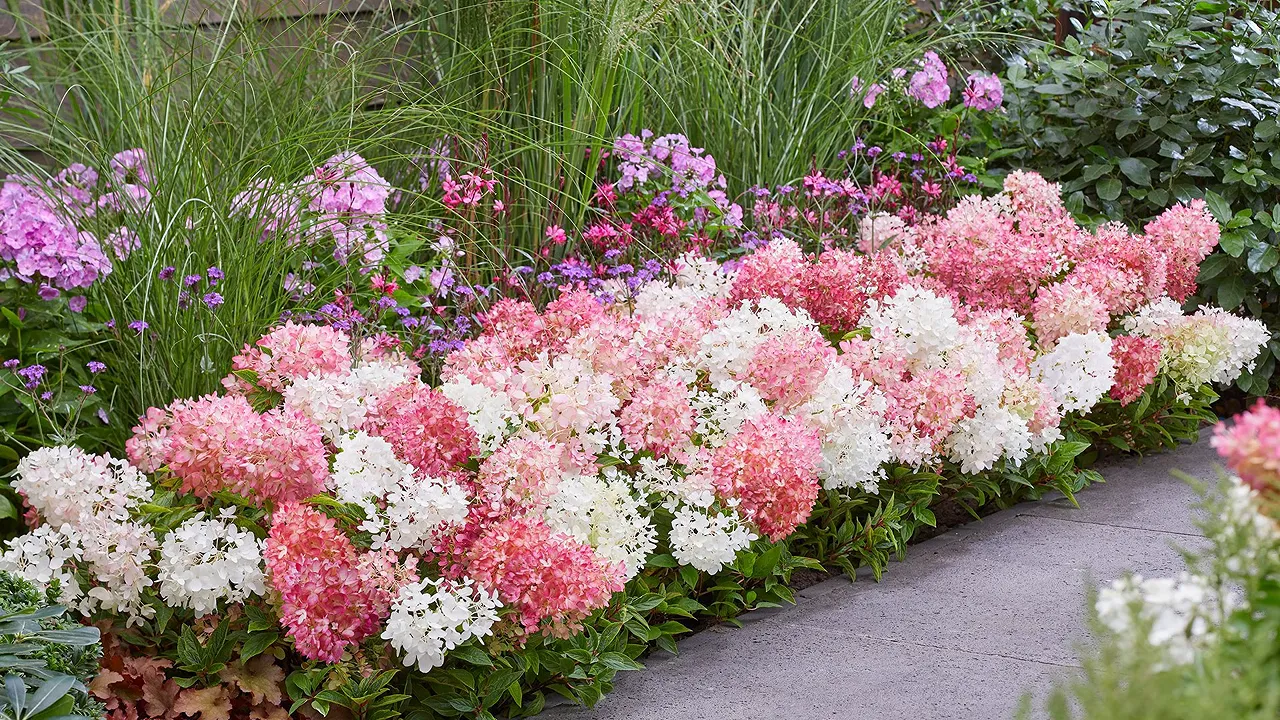
Blush opens white, then develops softer tones as summer progresses, finishing with pink coloration later in the season. It gives you that changing flower display that makes panicle hydrangeas so useful, just on a much shorter plant.
For a ground-covering planting, Alex described using four plants per square meter, an area of approximately 10.8 square feet. That gives a useful sense of the intended effect: several plants growing together into a low mass of flowers, rather than one large shrub standing by itself.
Groundbreaker Ruby: Deeper Pink and Red Flower Color
Ruby has the same low, spreading concept, with small leaves and fine branching. Its main distinction is the more intense flower color as the season develops.
The flowers begin green, move through white, and then take on deeper pink to reddish tones during summer. If the darker colors are what you enjoy most in panicle hydrangeas, this is the one that is going to get your attention.
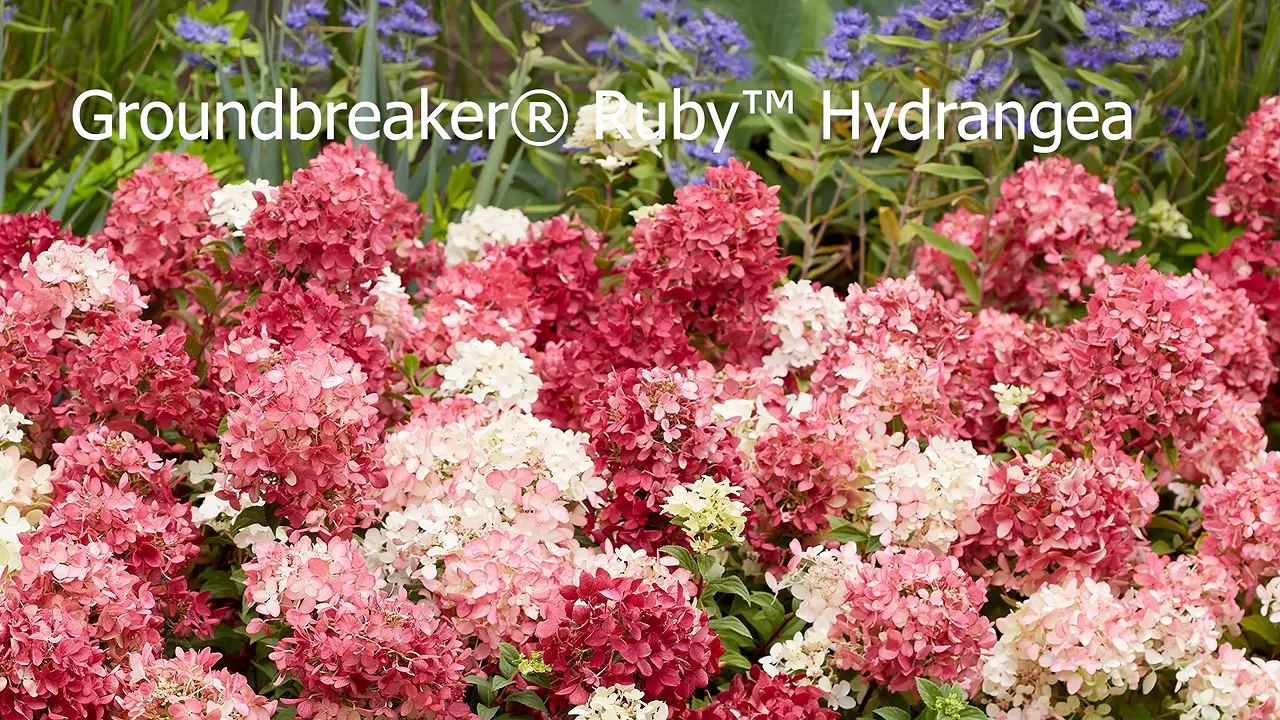
I asked Alex whether Ruby was the most sought-after variety. The darker pink tones are certainly popular, but he said interest in Ruby and Blush was fairly evenly matched.
That makes sense to me. One gives you a softer color progression, and the other gives you a stronger late-season color effect. The growth habit is the exciting part they share.
Groundbreaker Greeny: A Low Bedding of Green Flowers
Greeny takes a different direction. Rather than moving from white into pink, it starts with green flowers in early summer and shifts into softer green tones as summer continues.
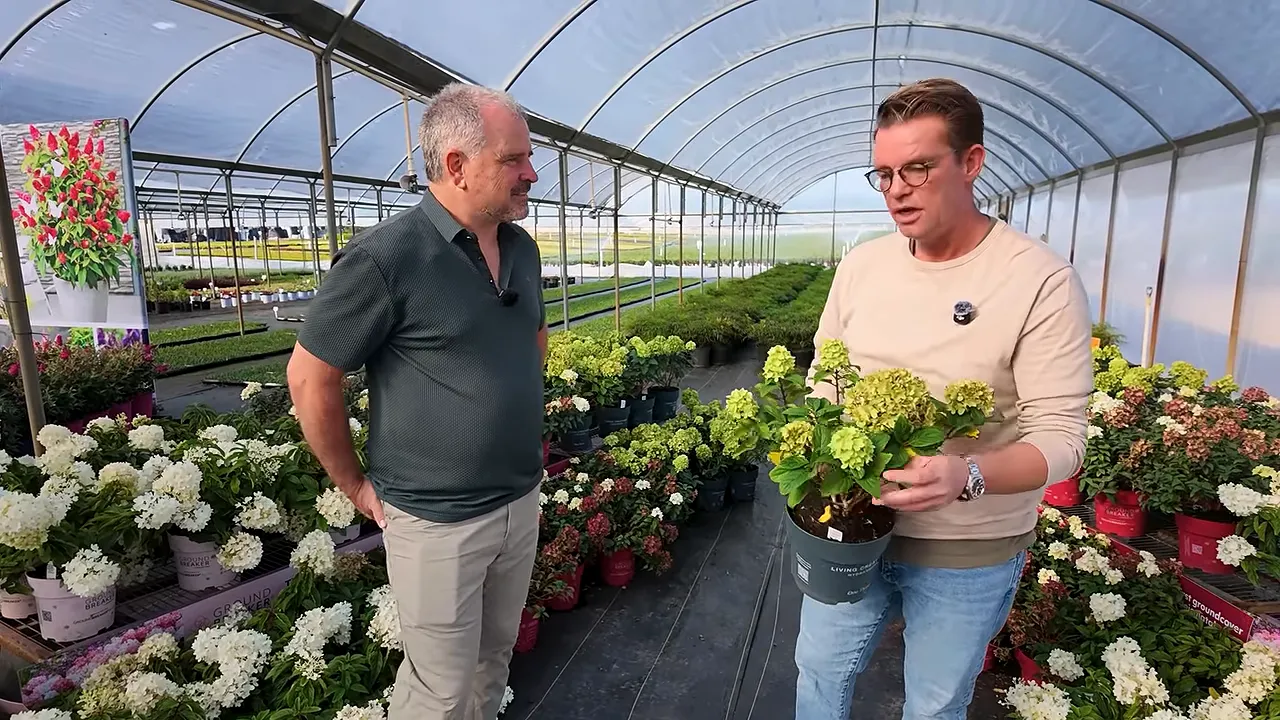
Eventually, the flowers turn brown as winter approaches. During the growing season, though, the effect Alex described is a low bedding covered with green flowers.
So the choice among the three is straightforward:
- Blush: White flowers that mature through soft tones into pink.
- Ruby: Green buds and early flowers that progress through white into deeper pink and red tones.
- Greeny: Green flowers that soften in color through summer before browning near winter.
Flowering on New Wood Makes Pruning Simpler
One of the important things to understand about these plants is that they flower on the current season’s growth. That is what gardeners mean when they say a hydrangea blooms on new wood.
Some hydrangeas carry their flower buds on older stems. With those, winter damage or pruning at the wrong time can remove the coming season’s flowers. Groundbreaker hydrangeas follow the panicle hydrangea pattern of producing flowers on new growth.
That is reassuring if the plant takes some winter damage, and it makes the annual pruning routine easier to understand.
When and How to Cut Them Back
Alex cuts these plants back annually at the end of winter, before spring growth begins. In the Netherlands, that generally means March. Your timing may be different, so the stage of the season matters more than a particular month.
- Wait until late winter or very early spring, before the plants begin active growth.
- Reduce the plant by roughly half, removing the old flower heads as part of the cutback.
- Allow the new shoots to develop, since those shoots will carry the season’s flowers.
I can prune some of my large panicle hydrangeas very hard, but a little Groundbreaker does not need the same dramatic treatment. The routine Alex described is a simple seasonal cutback appropriate to the plant’s small size.
Cold Hardiness and the Summer Flowering Season
We discussed Groundbreakers as having the broad hardiness associated with panicle hydrangeas, approximately USDA Zones 4 through 9. That puts them within reach of a lot of gardeners. Check the tag on the variety you purchase, and use the USDA Plant Hardiness Zone Map if you need to confirm your location’s zone.
Alex emphasized their winter hardiness and easy-growing nature. He also described them as having few disease concerns, which is another appealing part of the breeding work.
The flowering schedule is worth keeping in mind when shopping. Alex noted that many panicle hydrangeas begin flowering around July or mid-July, with the display continuing through August and September and toward the first frost.
A leafy plant at the garden center in spring is not a disappointing plant. It may simply be a month or two away from its flowering display.
Unfortunately, the busiest spring shopping period does not line up with peak panicle hydrangea flowering. If you find the variety you want in spring, look beyond the lack of flowers and consider what it will be doing later in the season.
Eight to Ten Years Behind a New Hydrangea
A plant like this does not move from an interesting seedling to a garden-center shelf overnight. Alex said developing a new product and bringing it to market generally takes eight to ten years.
His family’s nursery history goes back six generations in Boskoop, in the Netherlands, with roots there stretching back a couple of hundred years. The focused panicle hydrangea breeding work began about 20 years ago.
That degree of specialization is something I find fascinating about Boskoop. You can visit a nursery devoted to climbing hydrangeas, another growing Gaultheria, and another focused entirely on panicle hydrangeas. These are often multigenerational businesses with a tremendous depth of knowledge about their particular plants.
When Alex took over the company, he wanted it to do something distinctive. The decision was to concentrate on Hydrangea paniculata and work toward better plants within that group.
Groundbreaker and Living Creations Serve Different Roles
The breeding program has two collections. Groundbreaker focuses on the ground-covering forms. Living Creations includes a broader range of panicle hydrangeas.
That broader work is not all about making plants smaller. Some Living Creations selections have very large flower heads. Across the breeding program, Alex is working with white and pink flowers, small and large plants, and early and late flowering times.
The breeding fields are also evaluated for differences in flower color, stronger branches, and leaf quality. More selections are in development, but the goal is not simply to produce something different for the sake of being different.
Garden Performance Comes First
The most important part of our conversation was Alex’s explanation of what the breeding program is trying to achieve: a plant that performs well in the garden, not just one that looks impressive in a nursery pot.
Those are not necessarily the same thing. A plant can be selected to grow quickly, present well at retail, and sell. Alex’s stated priority is what happens after it goes home and becomes part of a garden.
That is the right emphasis. Growers need a workable plant, and homeowners need one that earns its space in the landscape. Ideally, those needs meet in the same selection.
Groundbreaker hydrangeas have already generated enough interest that gardeners are helping one another locate plants for sale. I understand the excitement. After seeing them in the Netherlands and then getting a closer look in Alabama, I am eager to get mine into the ground.
We have had plenty of beautiful panicle hydrangeas. What makes these stand out is the possibility of enjoying those flowers in a low, ground-covering form. That opens up a genuinely different way to use a familiar garden plant.


