Some gardens make you stop at the entrance. Others keep drawing you farther in. This private garden in Athens, Georgia, does both. It is one of the most amazing gardens I have visited, not because of one spectacular feature, but because there is so much to discover between one space and the next.
A narrow bridge leads into layered planting. Paths disappear around shrubs and beneath branches. Small waterfalls, shaded benches, open lawn, stone terraces, and densely planted water gardens appear along the way. Just when you think you have a feel for the place, the character changes again.
The individual plants are certainly worth a closer look, but the larger picture deserves attention first. What makes this garden extraordinary is the way plants, paths, water, and places to sit fit together.
Table of Contents
- An Entrance That Pulls You Into the Garden
- Woodland Planting With Plenty of Structure
- Stone, Water, and Quiet Places to Sit
- A Little Open Lawn Makes the Planting Feel Richer
- Arbors, Bamboo, and Changes in Enclosure
- A Water Garden Woven Through Paths and Rocks
- The Working Spaces Are Part of the Garden, Too
- What Makes This Private Garden So Memorable?
An Entrance That Pulls You Into the Garden
The opening approach sets the tone immediately. A bridge with black metal railings carries a simple walking surface through dense greenery. The dark railing gives the route a clear outline, while leaves and flowering branches soften everything around it.
Beyond the bridge, the path bends between rounded shrubs and tree trunks. There is no single, uninterrupted view that explains the whole garden. Instead, each turn offers enough of the next space to make you curious.
That is an important distinction. This is not simply a collection of attractive beds arranged beside a walkway. The route itself is part of the experience. Planting comes close to the edges, trees frame the approach, and the destination is often partly concealed.
A covered wooden sitting area appears early in the walk, tucked among the trees. It establishes another recurring feature: this garden has places to pause, not just places to pass through.
Woodland Planting With Plenty of Structure
Much of the garden has the enclosing feel of woodland. Tall trunks rise through several layers of shrubs, smaller trees, and low planting. Yet the spaces beneath them are anything but visually flat.
Look at the contrast between broad leaves and fine foliage, upright stems and rounded shrubs, dark green masses and pale or variegated leaves. Even where flowers are scattered rather than dominant, there is plenty going on.
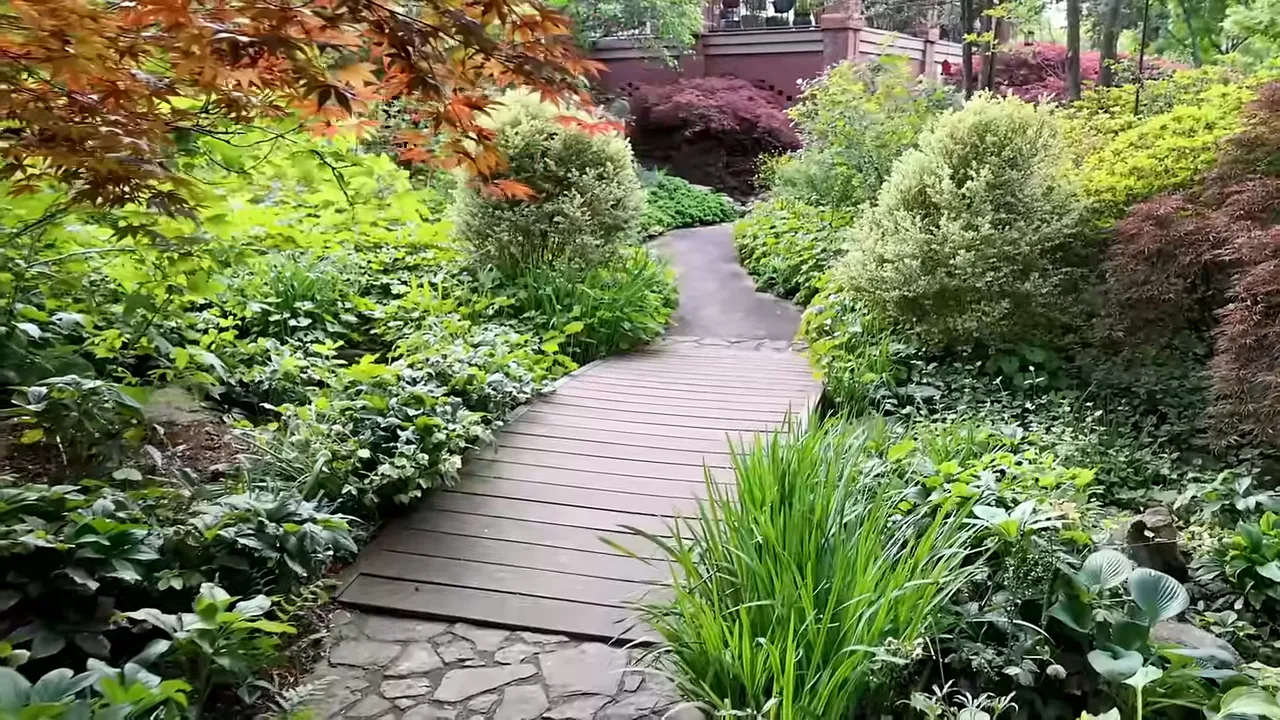
The planting repeatedly works at several heights:
- Tall trees provide the overhead framework and strong vertical lines.
- Smaller trees and substantial shrubs divide views and shape the spaces around the paths.
- Low foliage and groundcovers carry the planting down to the walking surface.
- Individual flowers, containers, and ornaments reward a closer look.
The result is dense, but it does not read as one undifferentiated mass. Rounded plant forms repeat throughout, giving the eye something familiar to follow. Between those forms, looser foliage creates a softer texture.
Small ornaments are nestled into these woodland scenes rather than isolated from them. A stone lantern, a pot beside a trunk, or a birdhouse above the foliage becomes a discovery along the route.
Stone, Water, and Quiet Places to Sit
Farther into the garden, the walking surfaces become more intimate. Narrow paths lead toward irregular stone paving, dark water, and small seating areas enclosed by plants.
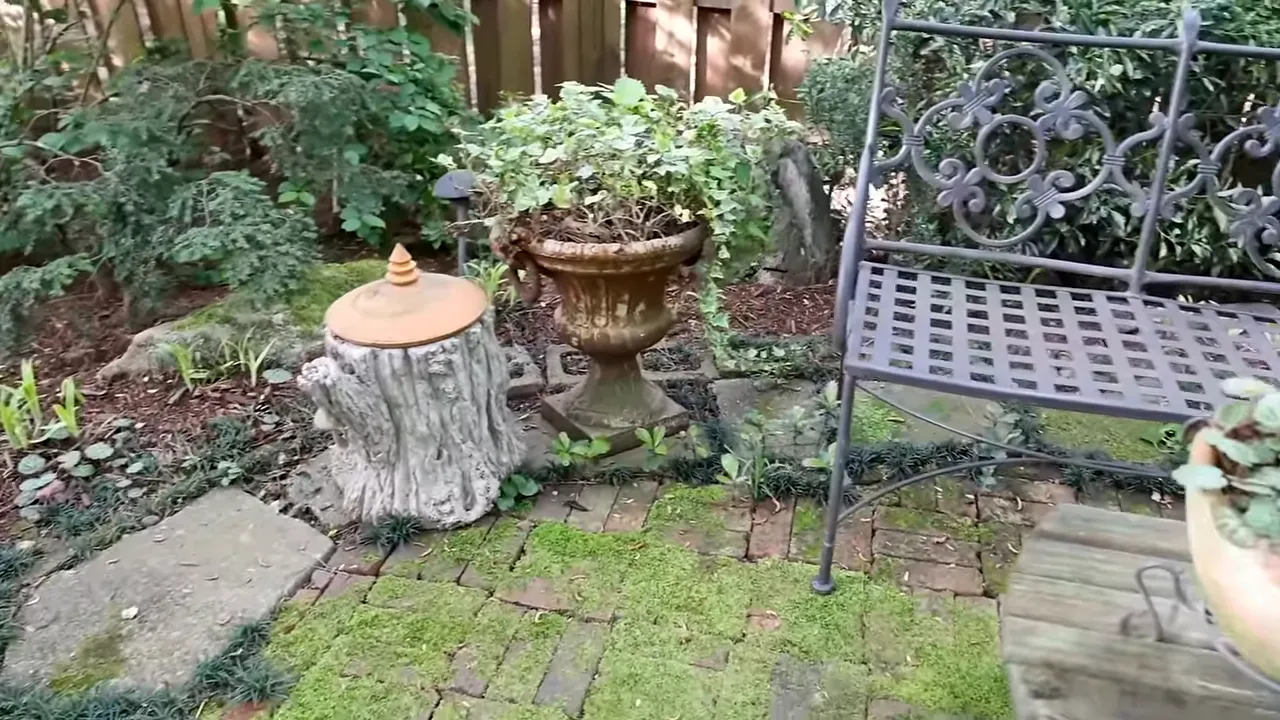
One particularly appealing corner combines a metal bench, containers, mossy joints, and a nearby rock-edged water feature. The paving is clearly defined, but green growth between the stones keeps it connected to the surrounding garden.
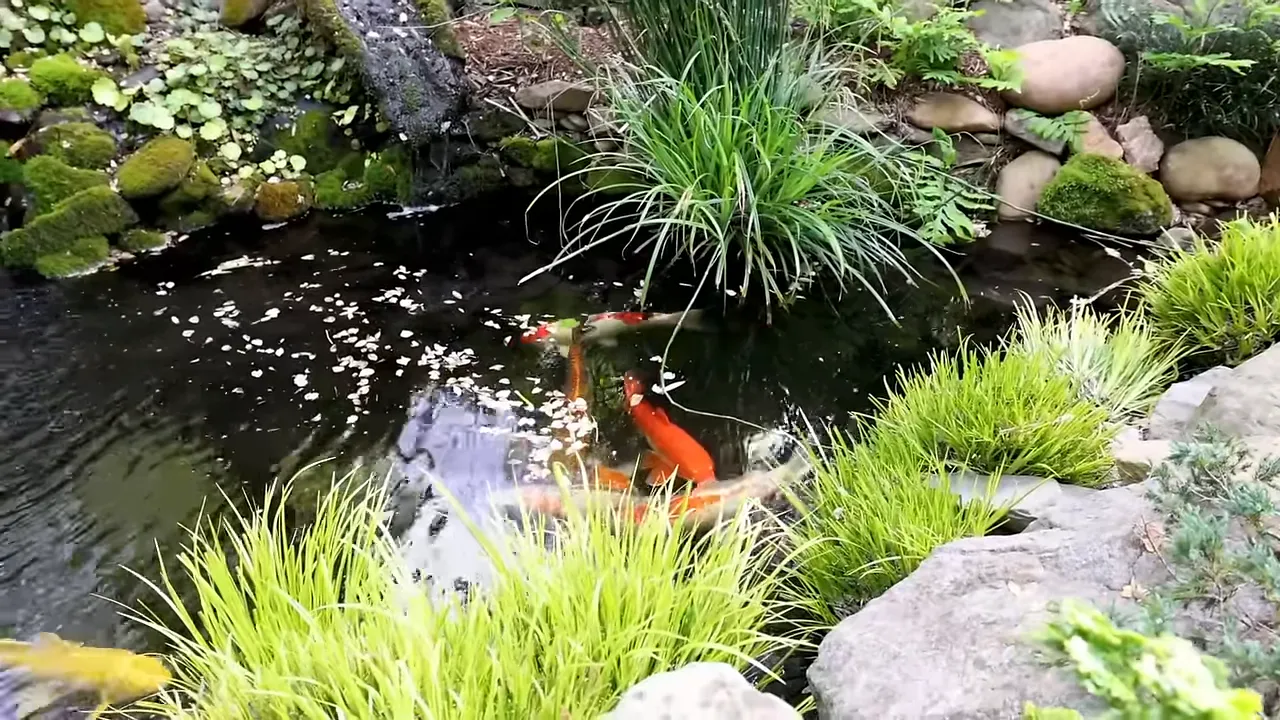
Water appears in several different settings. In one area, a small cascade drops between rocks beneath overhanging foliage. Elsewhere, a broader pond opens beside the path. Another view reveals brightly colored fish beneath the surface near a waterfall.
These are not bare pools with planting added as an afterthought. Rocks, low foliage, arching branches, and upright leaves meet the water at its edges. The pond belongs to the planting around it.
The seating is just as varied. There are individual benches, chairs grouped beneath cover, and broader terraces where several people could sit together. Each offers a different relationship to the garden: close to the water, under branches, or looking back across a planted space.
A good place to sit changes how a garden is experienced. Here, the chairs and benches make the surrounding detail feel worth lingering over.
A Little Open Lawn Makes the Planting Feel Richer
After the close woodland paths, an open lawn is a striking change. The grass creates a simple, uncluttered foreground, with curving beds, rounded shrubs, and contrasting foliage around its edges.
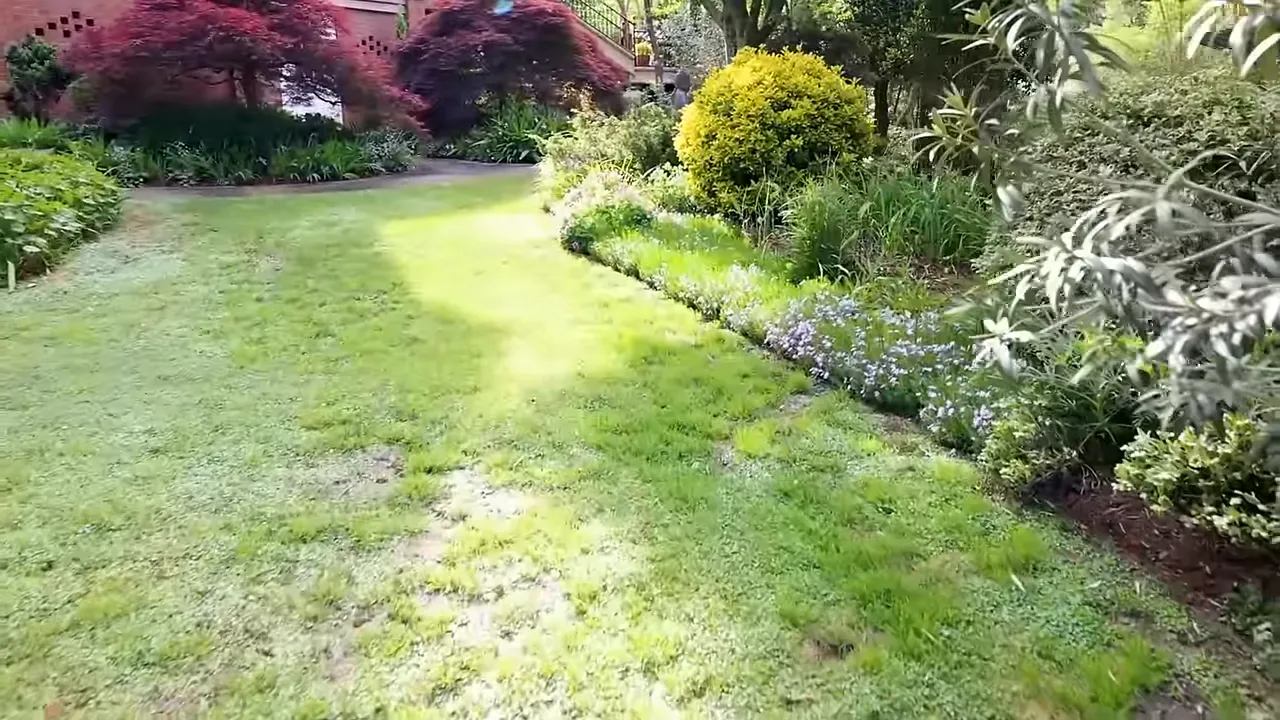
That openness matters because so much of the rest of the garden is filled with detail. From the lawn, it becomes easier to appreciate the outlines of the beds and the larger shapes of the shrubs.
Yellow-green foliage stands out against deeper greens. Burgundy foliage provides another strong contrast near the paths and buildings. Low edging plants trace the curves without competing with the larger forms behind them.
This is a useful relationship to notice: the lawn and the planting make each other more effective. The open area feels calm because the borders are rich, and the borders feel especially abundant because the foreground is simple.
Arbors, Bamboo, and Changes in Enclosure
Built structures help mark the transitions throughout the garden. Timber posts and overhead slats frame paths. Arbors announce an entrance without needing a solid wall. In other places, foliage does most of the enclosing.
A stand of tall, golden-colored bamboo stems creates one of the most distinctive spaces. The closely spaced vertical canes contrast with rounded shrubs, low planting, and containers at their base. Nearby stone paving and chairs give the area the feeling of an outdoor room.
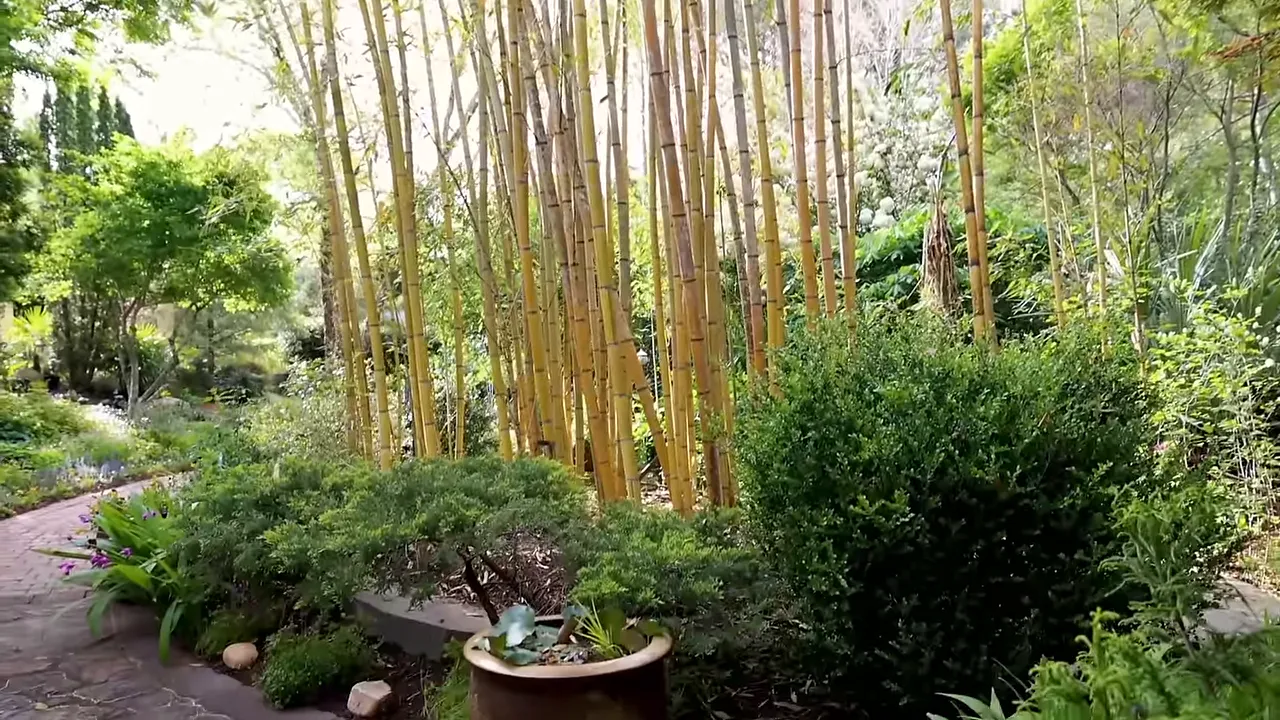
The effect is quite different from the broader tree canopy elsewhere. The bamboo creates a repeated vertical pattern, while the smaller plants keep the scene full at ground level.
Containers are used throughout these transitions. Some sit beside posts or steps; others gather around paved edges. They bring foliage close to the route and add another scale of detail between the paving and the larger landscape.
The garden keeps changing its degree of enclosure. A narrow passage gives way to a terrace. A shaded turn opens toward the house. A framed entrance leads back into dense planting. Those shifts keep the walk interesting without requiring every space to have a completely different palette.
A Water Garden Woven Through Paths and Rocks
Closer to the house, the relationship between water and circulation becomes especially striking. A narrow path runs beside small pools, while wooden walkways curve through a landscape of rocks, low shrubs, upright foliage, and yellow-green planting.
Here the water is not confined to a single distant focal point. It appears beside the route, disappears behind plants, and returns from another angle.
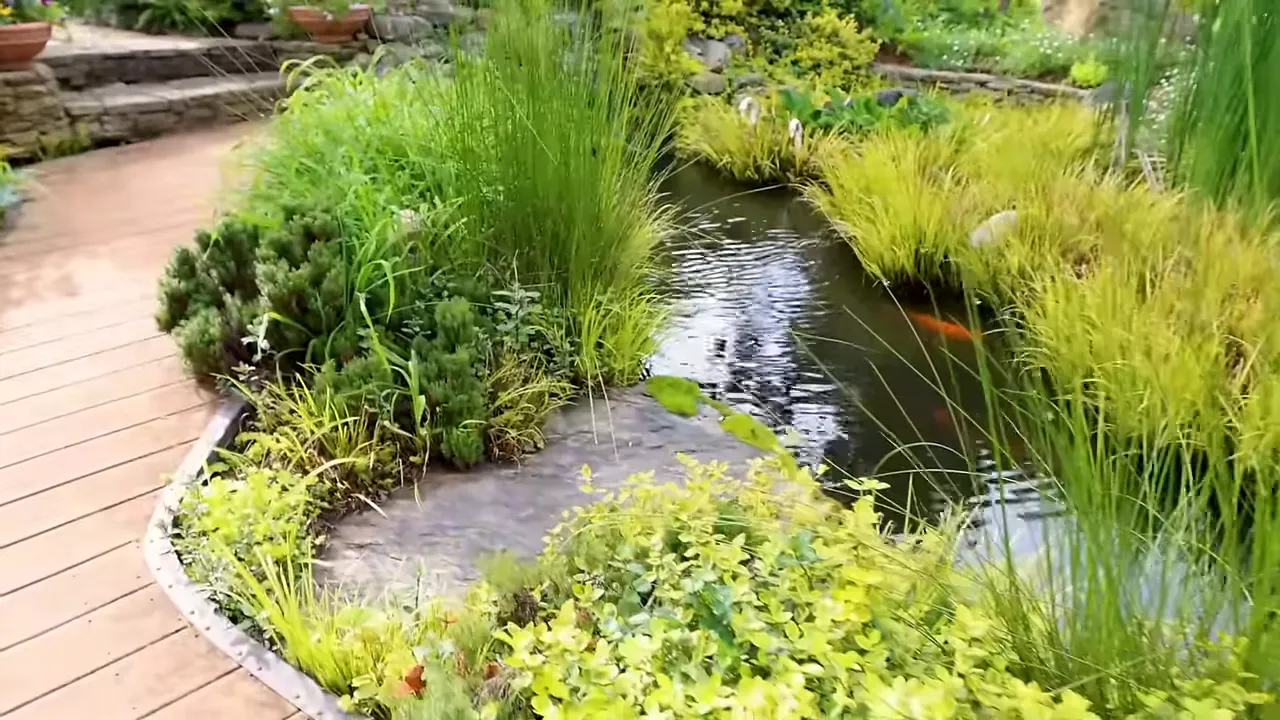
There is a tremendous amount of contrast in this area. Flat water sits beside rough stone. Narrow upright leaves rise above low spreading plants. The smooth line of the walkway passes through an irregular planted edge.
Larger rocks give the eye something solid to settle on among all that foliage. Small cascades and changes in level add further detail without making the planting feel secondary.
Later views revisit these same relationships from different directions. That is part of the pleasure of a garden with so many connected paths. A scene that first appeared beyond the water eventually becomes a place you can stand, and the earlier viewpoint becomes part of the background.
The Working Spaces Are Part of the Garden, Too
The route also passes through less formal areas: beds with support structures, brick-edged planting, groups of nursery containers, a greenhouse, and paths beside small buildings and mesh-sided enclosures.
These spaces provide a useful counterpoint to the finished terraces and water features. Pots waiting together and supplies near a path make it clear that this is a garden being worked in, not simply a series of polished scenes.
Even here, planting continues to define the route. Clipped shrubs sit beside building walls. Low foliage softens narrow paths. Flowering plants brighten the edges, and overhead greenery helps connect the buildings to the rest of the landscape.
The practical and ornamental areas do not feel entirely separate. The same recurring elements carry through: a clear path, rounded plant forms, layered greenery, and something interesting just beyond the next bend.
What Makes This Private Garden So Memorable?
It would be easy to focus only on the ponds or the quantity of plants. For me, the remarkable part is how consistently the whole garden holds together as the spaces change.
The final stretches return to familiar themes: shaded woodland paths, arbors, planted terraces, small waterfalls, and the richly textured water garden. Seeing them again reinforces how much of the design depends on relationships rather than isolated features.
- Paths reveal the garden gradually instead of presenting everything at once.
- Foliage supplies much of the interest through differences in color, texture, height, and shape.
- Open and enclosed spaces alternate, giving the walk variety.
- Water and seating are integrated into the planted spaces rather than set apart from them.
For more background on the property, the garden owner interview is a useful companion. For those considering their own landscape, University of Georgia Extension’s lawn and garden resources offer a practical place to continue researching.
Is this the most beautiful private garden? That is a difficult thing to measure. What I can say is that it offers something worth noticing at nearly every turn, while still feeling like one connected place. That is quite an accomplishment.


